№ 18 · BIOLOGY
700 bacterial species in the mouth: what they are for and how not to kill them
June 06, 2026 · QDRO Team
When microbiologists first applied next-generation sequencing to saliva, they expected to find a few dozen species. They found more than 700. The Human Microbiome Project, launched by the US National Institutes of Health in 2007, documented 775 bacterial species in the oral cavity alone — and that is without counting viruses, fungi, and archaea. The mouth turned out to be not merely a "gateway for infection" but a complex ecosystem whose balance shapes health far beyond its own borders.
A map of the oral microbiome: who lives here
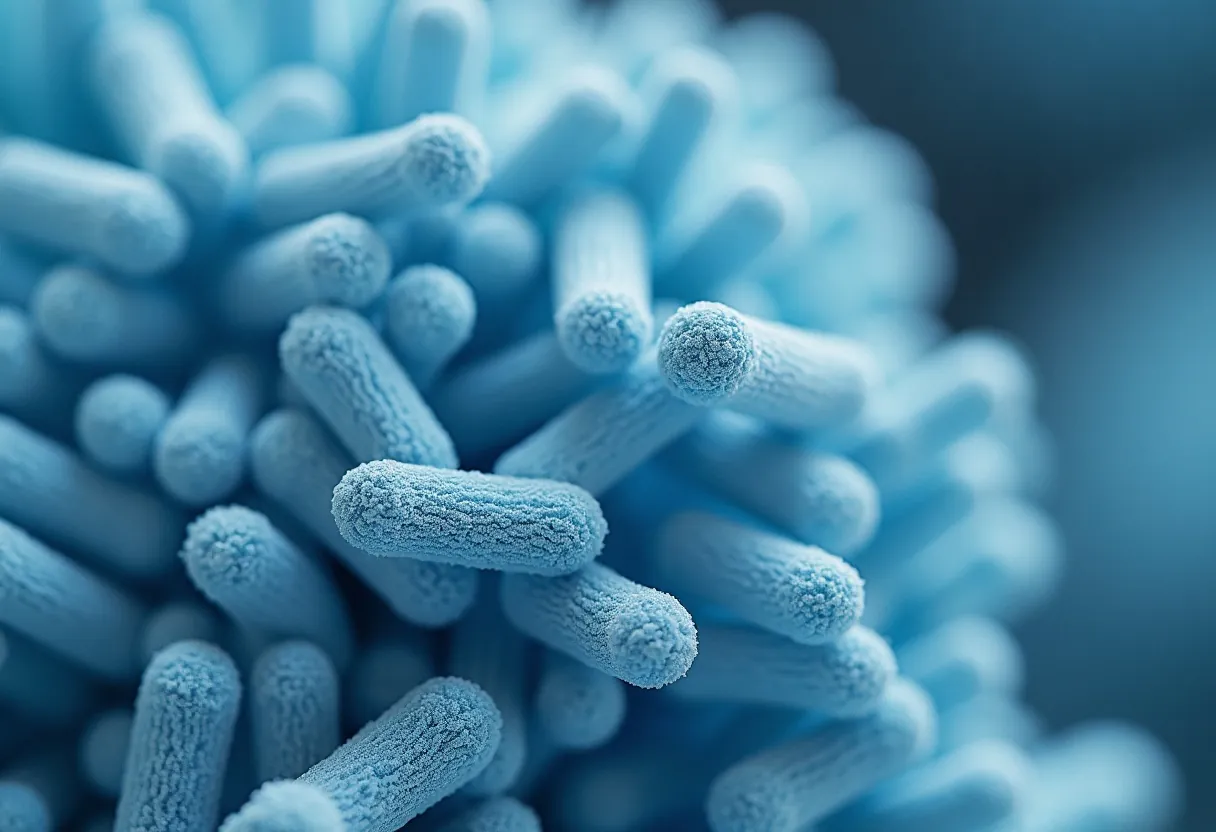
The Human Oral Microbiome Database (HOMD) project has cataloged more than 700 bacterial taxa from 13 phyla permanently resident in the mouths of healthy adults (PMID 20656903). Every anatomical niche — the tongue dorsum, the subgingival sulcus, the hard palate, the buccal epithelium, saliva — is populated by a community of its own. Streptococcus salivarius dominates the tongue; Veillonella and Prevotella form dense biofilms in subgingival pockets; Rothia dentocariosa and Actinomyces colonize the surface of the teeth.
If you sort all of this diversity into two camps — defenders and pathogens — the picture turns out to be unexpected. Most species hold neutral or symbiotic positions. There are few genuine villains: Streptococcus mutans and Lactobacillus ferment sugars into lactic acid, which dissolves enamel; Porphyromonas gingivalis, Tannerella forsythia, and Treponema denticola — the so-called "red complex" — set off chronic inflammation of the periodontium (PMID 9495612).
The key defender is Streptococcus sanguinis: it produces hydrogen peroxide, which suppresses the growth of S. mutans, and competes with it for adhesion sites on enamel. As long as S. sanguinis is present in normal numbers, cariogenic bacteria cannot take a dominant position. This is a textbook case of competitive exclusion inside a microbiome.
Dysbiosis: how the balance breaks down
The term "dysbiosis" does not simply mean that pathogens are present — it means that the ratio between species has shifted in a direction that is dangerous for the host. The mouth is one of the most thoroughly studied models of dysbiosis, because the plaque biofilm is easy to sample for analysis without invasive procedures.
The classic trigger of oral dysbiosis is an excess of fermentable carbohydrates. After every intake of sugar, the pH inside the biofilm falls below 5.5 — the critical threshold for the dissolution of hydroxyapatite. S. mutans and lactobacilli thrive in an acidic environment; S. sanguinis and S. gordonii do not. Repeated acid attacks gradually rebuild the community: the defenders are pushed out and pathogens take their place. This is why caries is a disease not of a bacterium but of an ecosystem (PMID 12624191).
Periodontitis follows a different logic. Its driving force is not acid but inflammation. P. gingivalis has evolved a remarkable strategy: it secretes proteases that dismantle the host complement system and reprogram neutrophils. As a result, the immune response does not eliminate the pathogen — it becomes the source of tissue destruction itself. This mechanism, the keystone pathogen hypothesis, was described in detail by Hajishengallis et al. in 2012 (PMID 22941505). And P. gingivalis itself accounts for <1% of the microbial biomass in affected pockets: it does not overwhelm its competitors by sheer numbers, it changes the rules of the game for the whole community.
P. gingivalis makes up less than 1% of the microbial biomass in periodontal pockets, yet it reprograms the host immune response through its proteases. The immune system does not destroy the pathogen — it becomes the source of destruction of periodontal tissue.
The consequences of oral dysbiosis are not confined to the mouth. A 2016 meta-analysis pooling data on 17,330 people (PMID 26638053) showed that periodontitis is associated with atherosclerosis of the carotid arteries. The mechanism has been confirmed in animal models: chronic oral infection with P. gingivalis accelerates the progression of atherosclerosis in apolipoprotein E-deficient mice (PMID 11854128). The oral microbiome is linked to type 2 diabetes, rheumatoid arthritis, Alzheimer's disease, and preterm birth — and the arrows of cause and effect point in both directions.
How mouthwashes kill the wrong bacteria
Antibacterial mouthwashes are one of the best-selling products in the oral care category. Their marketing rests on a simple idea: kill the bacteria and the problem is solved. Microbiology says otherwise.
Chlorhexidine (CHX) is the gold standard antiseptic in dentistry. It is effective in the treatment of acute infections and in the period following surgery. But when healthy people use it every day, its broad spectrum of action becomes a problem. A 2020 crossover study in 36 healthy volunteers (PMID 32210245) showed that a week of CHX twice a day measurably changed the composition of the microbiome and lowered the level of nitrite in saliva. Nitrate-reducing bacteria convert dietary nitrate into nitrite, which is then transformed into nitric oxide (NO). NO dilates blood vessels and lowers blood pressure. As nitrite fell, participants showed a trend toward rising systolic pressure. The effect is small — but it demonstrates that the oral microbiome takes part in cardiovascular physiology through the nitrate-nitrite-NO axis.
A week of CHX changed the composition of the salivary microbiome and lowered nitrite levels in 36 healthy volunteers. The result: a trend toward rising systolic blood pressure as the nitrate-nitrite-NO axis was suppressed.
Alcohol in mouthwash is another risk factor for the microbiome. Ethanol at the 5–27% concentrations typical of commercial products shifts pH and changes the composition of the biofilm. A study by Laumen et al. (PMID 38833520) found that daily use of an alcohol-containing mouthwash (Listerine Cool Mint) measurably increased the share of opportunistic anaerobes — Fusobacterium nucleatum and Streptococcus anginosus, previously linked to periodontal disease. Ethanol also reduces the secretion of saliva, and saliva is the mouth's main buffering system, carrying lysozyme, lactoferrin, IgA, and mucins.
The bounce-back effect matters as well: after a broad-spectrum antiseptic, the microbiome does not recover evenly. Faster-growing species — potential pathogens among them — recolonize the vacated niches before the slower-growing commensals manage to return. This phenomenon is well described for the gut microbiome after antibiotics and, judging by the available data, works the same way in the mouth.
Diet, saliva, and holding the balance
The most powerful lever over the oral microbiome is not a mouthwash but what you eat. Diet influences microbial composition in two ways: directly (substrates for fermentation) and indirectly (the composition and volume of saliva).
Diets high in fermentable carbohydrates shift the community toward cariogenic species within 4–5 days — as shown by Stephan's classic 1944 experiment, reproduced in modern molecular versions. The makeup of the diet is directly connected to the diversity of the subgingival microbiome: a cohort study showed that the pattern of carbohydrate intake is associated with the abundance and diversity of bacterial communities in dental plaque (PMID 35173205).
Green tea, pomegranate juice, and cranberries contain polyphenols that selectively inhibit the adhesins of S. mutans without suppressing the growth of S. sanguinis. This is a sensible selectivity, and one that is hard to reproduce with a chemical antiseptic. Probiotic lactobacillus strains, Lactobacillus rhamnosus GG in particular, reduced S. mutans counts and caries risk in children in randomized controlled trials when taken over a long period (PMID 11799281) — although the effect is moderate and depends on continued intake.
Saliva is an underrated player in maintaining microbial balance. A resting flow of <0.1 mL/min (hyposalivation) raises the risk of caries and periodontitis several times over: buffering capacity, the mechanical washing away of bacteria, and the delivery of antimicrobial proteins are all impaired. Hyposalivation is a frequent consequence of antidepressants, antihypertensives, and antihistamines, as well as of chronic stress acting through the sympathetic nervous system.
The same principle applies more broadly: work with the conditions of the environment rather than staging a total sanitization. Mouthwashes without chlorhexidine and without ethanol preserve the nitrate-reducing commensals and do not provoke the bounce-back effect.
What this means in practice
Understanding the oral microbiome turns the logic of oral care on its head. The goal is not sterility but balance. A few conclusions that follow directly from the data:
Frequency matters. A short acid attack after something sweet is normal; continuous acid exposure across five or six snacks a day is an ecological disaster for the microbiome. Gaps of >2 hours between meals let pH recover and give S. sanguinis a chance to hold its ground.
Antiseptics are for treatment, not for prevention. CHX and alcohol-containing mouthwashes have their place in clinical practice: in periodontal infection, in the postoperative period, in acute ulcerative gingivitis. Daily preventive use by a healthy person is excessive and, on the available evidence, potentially counterproductive.
Dietary diversity correlates with microbiome diversity. This holds for the gut and, judging by the accumulating data, for the mouth as well. Fiber, polyphenols, and nitrate-rich vegetables (beets, spinach, arugula) feed not only the host but also its microbial allies.
Mechanics matter. Brushing with a toothbrush and floss breaks up biofilm mechanically — more effectively than any chemistry, and without touching the planktonic commensals floating in saliva. This is precisely why mechanical hygiene remains the foundation, and mouthwash a supplement to it.
The 700 bacterial species in your mouth are not a threat that has to be eliminated. They are a working team that largely decides whether your teeth, your gums and — as it turns out — your blood vessels and joints will give you trouble. The task of sound hygiene is not to kill the team but to create the conditions in which the right players win.
Sources:
- PMID 20656903 — Dewhirst FE et al., J Bacteriol, 2010 — the Human Oral Microbiome Database catalogue: bacterial taxa from 13 phyla in the mouths of healthy adults
- PMID 9495612 — Socransky SS et al., J Clin Periodontol, 1998 — definition of the "red complex" of periodontal pathogens (P. gingivalis, T. forsythia, T. denticola)
- PMID 12624191 — Marsh PD, Microbiology (Reading), 2003 — the ecological hypothesis: oral diseases as "ecological catastrophes" of the microbiome
- PMID 22941505 — Hajishengallis G et al., Nature Reviews Microbiology, 2012 — the keystone pathogen hypothesis and the role of P. gingivalis in periodontal dysbiosis
- PMID 26638053 — Zeng XT et al., Int J Cardiol, 2016 — meta-analysis (17,330 participants): the link between periodontitis and carotid atherosclerosis
- PMID 11854128 — Li L et al., Circulation, 2002 — oral infection with P. gingivalis accelerates atherosclerosis in ApoE-deficient mice
- PMID 32210245 — Bescos R et al., Sci Rep, 2020 — chlorhexidine changes the salivary microbiome, lowers nitrite, and is linked to a rise in blood pressure
- PMID 38833520 — Laumen JGE et al., J Med Microbiol, 2024 — alcohol-containing mouthwash (Listerine) increases the share of Fusobacterium nucleatum and S. anginosus
- PMID 35173205 — Millen AE et al., Sci Rep, 2022 — carbohydrate intake is associated with the abundance and diversity of the subgingival microbiome
- PMID 11799281 — Näse L et al., Caries Research, 2001 — Lactobacillus rhamnosus GG reduces S. mutans and caries risk in children in an RCT