№ 51 · HOWTO
What Water to Put in Your Water Flosser — and Why You Can't Save It for Next Time
July 21, 2026 · QDRO Team
You fill the tank, floss, and half of it is still there. Pouring it out feels wasteful — the frugal instinct says leave it, top it up tonight. Or the opposite: fill it generously, enough for a couple of days, so you don't have to bother each time. It looks like a trivial choice. But the real question behind "what water to put in a water flosser" isn't about hardness or minerals — it's about freshness. Because of how the device is built, standing water inside it isn't just water that will wait for you. It's an environment with a life of its own. And here the convenience of stocking up collides head-on with safety — which is anything but obvious to the eye.
A water flosser is a narrow tube of standing water
The problem isn't the water itself. It's the geometry. Inside the device sit a reservoir, a pump, and a thin channel that carries water to the tip. While you're using it, the water moves. The moment you switch off, it goes still — trapped in a warm, damp, dark volume with a large surface of walls. To microbes, that isn't "clean tap water." It's a ready-made home.
This isn't unique to a home flosser. The exact same physics has plagued dental unit waterlines (the thin tubes that feed water to a dental drill's handpiece) for decades. They've been studied for years precisely because a narrow channel of standing water inevitably grows biofilm — a film of bacteria glued together by their own slime, clinging to the walls, that a simple stream won't rinse away. The mechanism is identical; only the scale changes. For how it's built and why it's so stubborn, see our breakdown of biofilm: how it forms and why it's hard to remove.
How serious this gets is clear from clinical measurements. On dental waterline walls, researchers find tens of thousands of bacterial colonies — counts in the thousands of CFU (colony-forming units) per sample.
Measurements of biofilm on dental unit waterlines: before treatment, tubing walls carried on the order of 1.6×10⁴ colony-forming units; after thorough disinfection the count dropped roughly tenfold. Direct confirmation that a narrow channel of standing water colonizes as a matter of course. PMC9868918
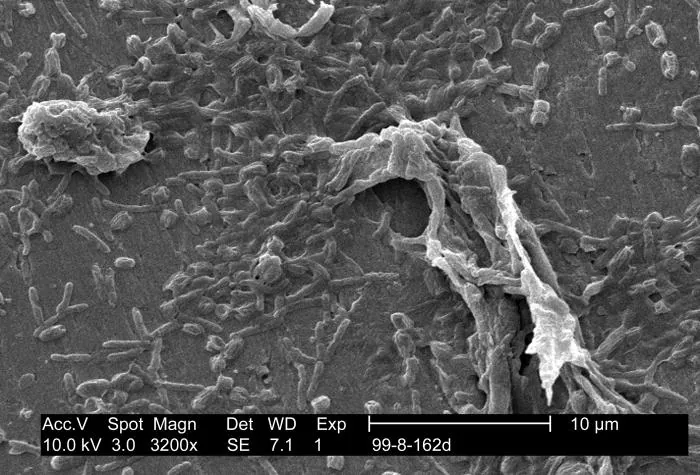
And here's the key part: biofilm can't simply be "rinsed off." A disinfectant kills the bacteria it reaches but doesn't destroy the film itself — and within days to weeks the colonies grow back.
A classic review: chemical treatment of waterlines removes live bacteria from the water but doesn't break down the biofilm matrix on the walls — and recurrence follows quickly. Hence a simple conclusion: a one-time water change doesn't solve the wall problem. J Am Dent Assoc, 1999. PubMed 9919033
What grows in the tank over three weeks
Everything above is about dental tubing. The fair question is: is a home water flosser really the same story? It turns out yes — and this is no longer an analogy but a direct measurement.
Researchers took an ordinary electric water flosser and had people use it normally — every day. After three weeks, they examined the tip. A bacterial film had grown on it: both aerobic and anaerobic species, some of them from the user's own oral microbiota. In other words, the device wasn't just accumulating random microbes from the water — it was being colonized by bacteria from the mouth, then spraying them back through the jet. Three weeks of normal use, and the loop closed.
Pilot study: after three weeks of daily use, both aerobic and anaerobic bacteria were found on a water flosser's tip, including species resembling the user's oral microbiota — which were then dispersed by the water jet. The device tested was an air-water flosser (Sonicare AirFloss), not a classic pump-driven irrigator; but any device of this kind fouls with standing water — the mechanism is shared. Clin Exp Dent Res, 2021. PubMed 34037327
One more detail: even bottled water left open for a couple of weeks stops being "just water." In a standing volume, microbes multiply regardless of how clean the water was to begin with. A flosser reservoir is exactly such a volume — only warm and closed.
Warm water is an incubator
Here's the uncomfortable paradox. We fill a flosser with warm water for a reason: a cold stream on the gums is unpleasant, especially with sensitivity, so a comfortable temperature for the procedure is around 35–40 °C. But that's also close to the ideal temperature for most household bacteria to reproduce.
The microbes that thrive in this range are called mesophiles (microbes whose growth optimum is near body temperature). The warmer the water in a stagnant tank, the faster they divide. The logic is unforgiving: what makes the procedure pleasant also speeds up microbial growth in a standing reservoir. Warm water left "until evening" isn't storage — it's incubation.
From the tank to a hospital bed: a real case
Up to here everything was abstract: CFU, biofilm, temperature optima. Now — a person in a hospital bed.
A case described in France takes this topic out of the theoretical. A patient was hospitalized with Legionnaires' disease (a severe pneumonia caused by the Legionella bacterium, which multiplies precisely in stagnant warm water). Doctors went looking for the source of infection. It turned out to be the patient's home water flosser: the same Legionella — Legionella pneumophila serogroup 1 — was isolated from the device's reservoir and jet, at about 300 CFU per liter of water.
But the strongest part isn't the finding itself — it's the proof. The genomes of the bacterium from the patient's lungs and the bacterium from the flosser were sequenced in full and compared. They were identical — one and the same genetic type. This isn't "could theoretically have been infected." It's a proven chain: device → illness, confirmed by genetics. Everything we walked through above — the narrow tube, the biofilm, the warm incubator — converges here into a single resolution.
Keep the proportion in mind. The patient was immunocompromised (undergoing a stem cell transplant) — that is, especially vulnerable. This is a single documented case, not a typical scenario for a healthy person. But as an illustration of the mechanism it's flawless: non-sterile water plus the absence of regular cleaning turned a household device into a source of infection, and genetics proved it.
An immunocompromised patient developed Legionella pneumonia; the source proved to be their home water flosser — Legionella pneumophila serogroup 1 (about 300 CFU/L) was isolated from the reservoir and jet. Whole-genome sequencing showed the lung strain and the device strain to be identical. Emerg Infect Dis, 2026;32(2). PubMed 41714876
What the manufacturer itself says
This isn't scare-talk from enthusiasts — it's exactly what the manufacturer writes. Waterpik, one of the oldest irrigator brands, states plainly in its official FAQ: empty any remaining water from the reservoir after each use. More than that, among the causes of leaks it names water left in the tank between uses. Tips, meanwhile, are recommended for replacement every three to six months for hygiene.
Translated from the language of instructions into the language of habit: the reservoir isn't meant to hold water from one session to the next. An empty tank after every use isn't over-caution — it's the standard mode, written down by the people who built the device.
The manufacturer instructs users to empty remaining water from the reservoir after each use and lists water left in the tank between uses as a cause of leaks; tips are recommended for replacement every three to six months. Official Waterpik support page. waterpik.com
And if you add something to the water
A separate question is when people add something to the water — a mouthwash, an antiseptic, a concentrate. The same logic applies here, only with a double edge.
Any diluted active without a preservative is vulnerable on two fronts. First, it becomes a nutrient medium for microbes itself — sugars, flavorings, and organics in solution only help bacteria along. Second, a diluted substance loses stability. A telling example is chlorhexidine: in a lab study, at a high concentration (5 mg/ml) it showed precipitation (the substance dropping out as solids) in about an hour, depending on the diluent. A pre-diluted "week's supply" bottle works against you twice: the active degrades while the solution is colonized by microbes.
A lab assessment of diluted chlorhexidine stability: in saline, a high concentration (5 mg/ml) precipitated in about an hour, whereas in water for injection there was no precipitate for up to 48 hours. There's no direct study of flosser concentrates here — it's an illustration of a general pharmaceutical principle: a diluted solution isn't stored. J Allergy Clin Immunol Glob, 2024. PMC11719288
It's worth separating the reasons. Water is the base: a clean jet cleans mechanically, by sheer flow. But if you want the stream to do more than rinse — to carry fewer bacteria into an inflamed gum — there's a format built for exactly this: a concentrate for the irrigator, a few drops per reservoir that make the water mildly antibacterial and fresh. An additive like this works on the flow — it doesn't strip the deposits from the device's walls. One important nuance: an ordinary mouthwash isn't something you just pour into the tank — alcohol, surfactants, and foam are hard on the pump and the seals, and manufacturers themselves advise at least diluting it and rinsing the device afterwards. Which is exactly why a format made for the irrigator makes sense: foam-free, without aggressive surfactants, economical — you work in drops, not bottles. And, by the same storage logic, only a fresh dose per fill — not diluted stock laid in for later.
Hence a category-level takeaway, with no tie to specific products: if you add anything to the water at all, dilute it per portion — a dose for one fill, fresh each time, rather than a large diluted container for the week. The same principle as with the water itself: freshness beats stockpiling.
How to do it right: fresh water every time
Let's fold it all into a simple routine. To the question "what water to put in a water flosser," the short answer is this: fresh — for every session, not stockpiled in advance.
- Fill only what you need for one use. One tank, one procedure. Portable models usually hold 140–330 ml (most often around 200 ml), countertop ones 600–1000 ml; either way the logic is the same — a fill is meant for the current session, not for a week ahead.
- Empty the reservoir after use. Don't leave it to "top up tonight": by evening that's already different water, settled and colonized by microbes.
- Clean the device regularly. A monthly flush of the tank and channels — because changing the water doesn't remove biofilm from the walls (more on that below). It's the walls the water can't reach: that's exactly what device-cleaning products are for — including effervescent cleaning tablets (the same category as denture tablets), which dissolve the deposits and biofilm the water stream never gets to.
There's no special "right water" to hunt for: for most household flossers, ordinary drinking water at room or slightly warm temperature is fine. Safety is decided not by the water's source but by whether it's fresh or stagnant. And one more thing: a flosser is about the spaces between teeth and the gums, but it replaces neither a toothbrush nor floss. Why these tools solve different problems — in our separate breakdown, floss, irrigator, or interdental brush: what science says.