№ 19 · EVIDENCE
Floss, Irrigator, Interdental Brush: What Cleans Better — and When
June 06, 2026 · QDRO Team
Most people in Russia use nothing beyond a toothbrush. Yet a toothbrush physically cannot reach the spaces between the teeth — precisely where enamel and the marginal periodontium are most vulnerable. Those surfaces account for roughly 40% of the total tooth area, but they stay out of reach of the bristles under any brushing technique. This is where most adult caries begins, and where practically all chronic gingivitis takes hold.
Industry answers this problem with three classes of tools: dental floss, the oral irrigator, and interdental brushes. Advertising promotes each of them as the "best" choice. But what do controlled clinical trials actually say?
Floss: the gold standard, with caveats
Floss — the oldest interdental hygiene tool — remains the official recommendation of the American Dental Association and of most national protocols. The rationale is mechanistically sound: the thread physically enters the subgingival space, mechanically disrupts the biofilm, and evacuates debris.
The evidence base for an anti-caries effect of floss, however, is essentially absent. The Cochrane review by Sambunjak et al. (2011, PMID 22161438), devoted specifically to flossing, stated it plainly: not one of the included trials reported any caries data at all — meaning the effectiveness of floss in preventing caries in adults has not been confirmed by controlled studies. As for gingivitis, the updated Cochrane review by Worthington et al. (2019, PMID 30968949) confirmed that interdental cleaning in addition to brushing reduces gingivitis more than brushing alone, but the evidence was rated "low to very low quality" because of methodological limitations — short follow-up periods and inconsistencies in randomization methods.
The fundamental problem with floss is technique and adherence. That same Cochrane review by Sambunjak et al. (2011, PMID 22161438) noted only "weak, very unreliable" evidence of plaque reduction — the result depends heavily on technique, which is hard to reproduce outside clinical conditions. In everyday practice the effectiveness of floss drops further still: poor technique, with the thread sawing across the tissue instead of hugging the tooth in a C shape, not only reduces plaque removal but traumatizes the papilla.
Interdental brushes: the data favor the brush
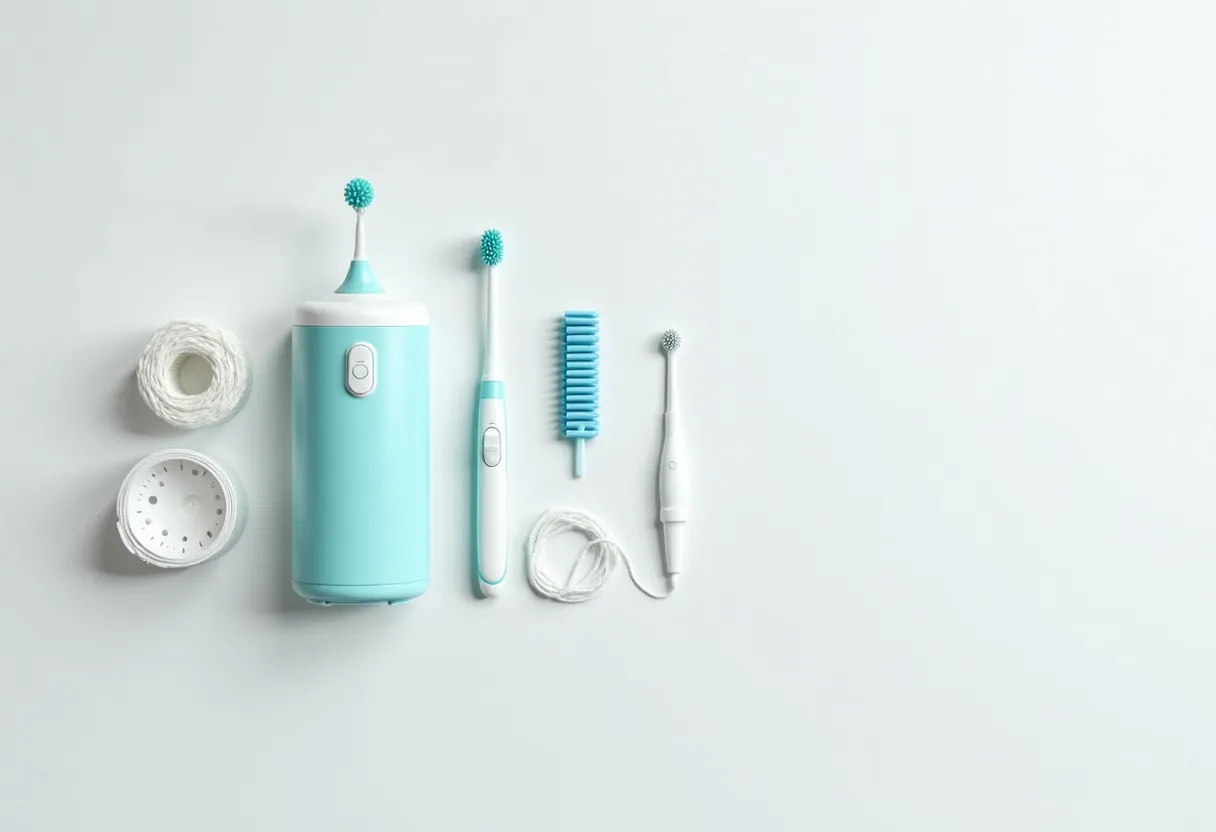
Small cylindrical or conical brushes on a wire stem are arguably the most underrated interdental hygiene tool in Russia. In Scandinavia they became the primary recommended device back in the 1990s. The basis is geometry: an interdental brush fills the entire embrasure with its volume, whereas floss merely slides along the surfaces.
The systematic review by Slot et al. (International Journal of Dental Hygiene, 2008, PMID 19138177), covering 9 publications, recorded a statistically significant advantage of interdental brushes over floss on the plaque index: in most of the studies the reduction was more pronounced with the brushes. The later meta-review by Sälzer et al. (Journal of Clinical Periodontology, 2015, PMID 25581718) confirmed it: on combined reduction of the plaque index and the bleeding index, interdental brushes outperform floss in patients with open embrasures — that is, in the presence of gum recession, loss of bone height, or wide anatomical contacts.
The key limitation: an interdental brush works only when the space allows the tool to be inserted without force. The sizing rule is that the metal stem must not deform as it passes through. The wrong size is not merely ineffective: a brush of larger diameter pushes the papilla apart and can provoke recession. According to the clinical guidelines of the European Federation of Periodontology, in young patients with no recession and tight interdental contacts, floss remains preferable for exactly this reason.
A meta-analysis of 9 RCTs showed a statistically significant advantage of interdental brushes over floss on the plaque index in patients with open embrasures.
The irrigator: the best tool against gingivitis
An oral irrigator delivers a pulsed jet of pressurized water into the interdental spaces and the subgingival sulcus — to a depth of up to 6 mm according to direct measurements. Its mechanism of action differs fundamentally from mechanical cleaning: hydrodynamic pressure disrupts the biofilm and flushes fluid out of the sulcus, lowering the inflammatory load on periodontal tissues.
The randomized controlled trial by Ren et al., published in the International Journal of Environmental Research and Public Health in 2023 (PMID 36834421), enrolled 90 patients with gingivitis, split into a "brush + irrigator" group and a "brush only" group. By week 4 the irrigator was already statistically significantly better than the control on the modified gingival index, the bleeding index, and the proportion of sites with bleeding on probing (p = 0.001 for BI and BOP%). On the plaque index the irrigator's significant advantage appeared later, at week 8: hydrodynamic disruption of mature biofilm proceeds more slowly than its physical removal by floss or a brush.
This is the crucial distinction: floss and interdental brushes remove plaque better; the irrigator controls inflammation better. For patients with chronic gingivitis, type 2 diabetes, or immunosuppression, the irrigator addresses the clinically more important problem. For patients with a high caries risk and minimal inflammation, mechanical removal of the biofilm takes priority.
Floss and interdental brushes remove plaque better; the irrigator controls inflammation better. The right choice depends on the clinical situation — not on a brand's advertising.
A separate niche is patients with orthodontic appliances. The RCT by Sharma et al. (American Journal of Orthodontics and Dentofacial Orthopedics, 2008, PMID 18405821) showed that a water jet with an orthodontic tip significantly outperforms floss in reducing plaque and bleeding in adolescents with fixed braces. Flossing through an archwire is technically awkward and requires special floss threaders, which lowers adherence further.
A randomized trial in Int J Environ Res Public Health: brush + irrigator vs. brush alone. The irrigator significantly reduces bleeding and gingivitis as early as week 4 (p = 0.001), and plaque by week 8.
When to use what: a decision matrix
The RCT data add up to a reasonably clear matrix:
Young patient, tight interdental contacts, no recession, no inflammation: floss — the only tool that will enter a tight contact without trauma.
Adult patient with early recession or widened embrasures: an interdental brush — plaque reduction is statistically significantly better than with floss; the size is chosen on the principle of "the largest one that goes in without force."
Patient with chronic gingivitis, diabetes, or after periodontal treatment: an irrigator — inflammation control is significantly better than with floss; used alongside the toothbrush, not instead of mechanical cleaning.
Braces or fixed orthodontic appliances: an irrigator — plaque removal around the brackets is significantly better than with floss according to RCT data.
Implants: the irrigator is preferable — floss carries a risk of introducing bacteria subgingivally, and an interdental brush of the wrong size can scratch the implant surface.
The combined approach: 1 + 1 > 2
The systematic review and network meta-analysis by Slot et al. (Journal of Clinical Periodontology, 2020, PMID 32716118) recorded that no single tool on its own provides full control over interdental hygiene. The best results across the full set of outcomes — plaque, gingivitis, bleeding — came from combining a toothbrush with one or two interdental tools.
The logic of the combination depends on the risk profile. For a patient with no inflammation and tight contacts, a toothbrush plus floss twice a day is enough. For a patient with a history of periodontitis, a three-part routine makes sense: brush + interdental brush (mechanical disorganization of the biofilm) + irrigator (anti-inflammatory control). With braces: brush + irrigator + a floss threader for the final pass.
The order of use does matter, though. The RCT by Mazhari et al. (Journal of Periodontology, 2018, PMID 29741239) showed that the "floss first, then brush" sequence reduced interdental plaque statistically significantly more (p = 0.001) and increased fluoride retention in the interdental space (p = 0.027) compared with the reverse order. The practical conclusion: it is smarter to clean between the teeth before brushing — that way the fluoride in the toothpaste penetrates the cleaned space better.
What this means in practice
The only universally bad choice is to skip interdental hygiene altogether. Every other decision is acceptable as long as the tool matches the anatomy and the clinical situation.
When QDRO's dentists put together recommendations for patients, this is exactly the matrix they rely on: the tool is matched to the space, not the other way around. If an interdental brush goes in, it will be more effective than floss. If there is gingivitis, an irrigator is added to mechanical cleaning. If no tool goes in without discomfort, that is a reason for a professional examination — not a reason to give up on interdental hygiene.
The evidence base here is mature enough to support specific conclusions. The three classes of tools solve different problems, and the right combination depends on your mouth — not on the advertising for a particular brand.
Sources:
- PMID 36834421 — Ren et al., International Journal of Environmental Research and Public Health, 2023 — RCT in 90 patients: brush + irrigator vs. brush alone, on the gingival, bleeding, and plaque indices
- PMID 22161438 — Sambunjak et al., Cochrane Database, 2011 — floss + brush vs. brush: reduction in gingivitis; no trial reported caries data; the plaque evidence was "weak and very unreliable"
- PMID 30968949 — Worthington et al., Cochrane Database, 2019 — interdental devices in addition to brushing: prevention of periodontal disease and caries; quality of evidence low/very low
- PMID 19138177 — Slot et al., International Journal of Dental Hygiene, 2008 — systematic review of 9 publications: interdental brushes vs. floss on the plaque index
- PMID 25581718 — Sälzer et al., Journal of Clinical Periodontology, 2015 — meta-review: effectiveness of mechanical interdental hygiene in gingivitis
- PMID 32716118 — Slot et al., Journal of Clinical Periodontology, 2020 — systematic review and network meta-analysis of mechanical plaque removal in patients on supportive therapy
- PMID 29741239 — Mazhari et al., Journal of Periodontology, 2018 — RCT: the "floss → brush" sequence reduces interdental plaque and increases fluoride retention more than the reverse order
- PMID 18405821 — Sharma et al., American Journal of Orthodontics and Dentofacial Orthopedics, 2008 — RCT: water jet with an orthodontic tip vs. floss in adolescents with braces