№ 54 · CARE
Bristles Splayed Within a Month: Your Brush Recorded Your Technique
August 13, 2026 · QDRO Team
Bristles splay out into a fan, and the explanation is ready before the question: bad fiber, or "too soft to hold its shape." But a bristle field tells you nothing about the quality of the fiber. It works like a chart recorder: it logs the force and strokes it was pressed against teeth with. Splayed within a month means the brush was used as a scraper, not as a brush.
"It Frayed, So the Bristle Must Be Bad"
The myth survives on a swap: a flared field is read as a property of the product, when it is a property of use. Every brush flares — any stiffness, price, polymer. The only variable is how long that takes, and the hand sets it.
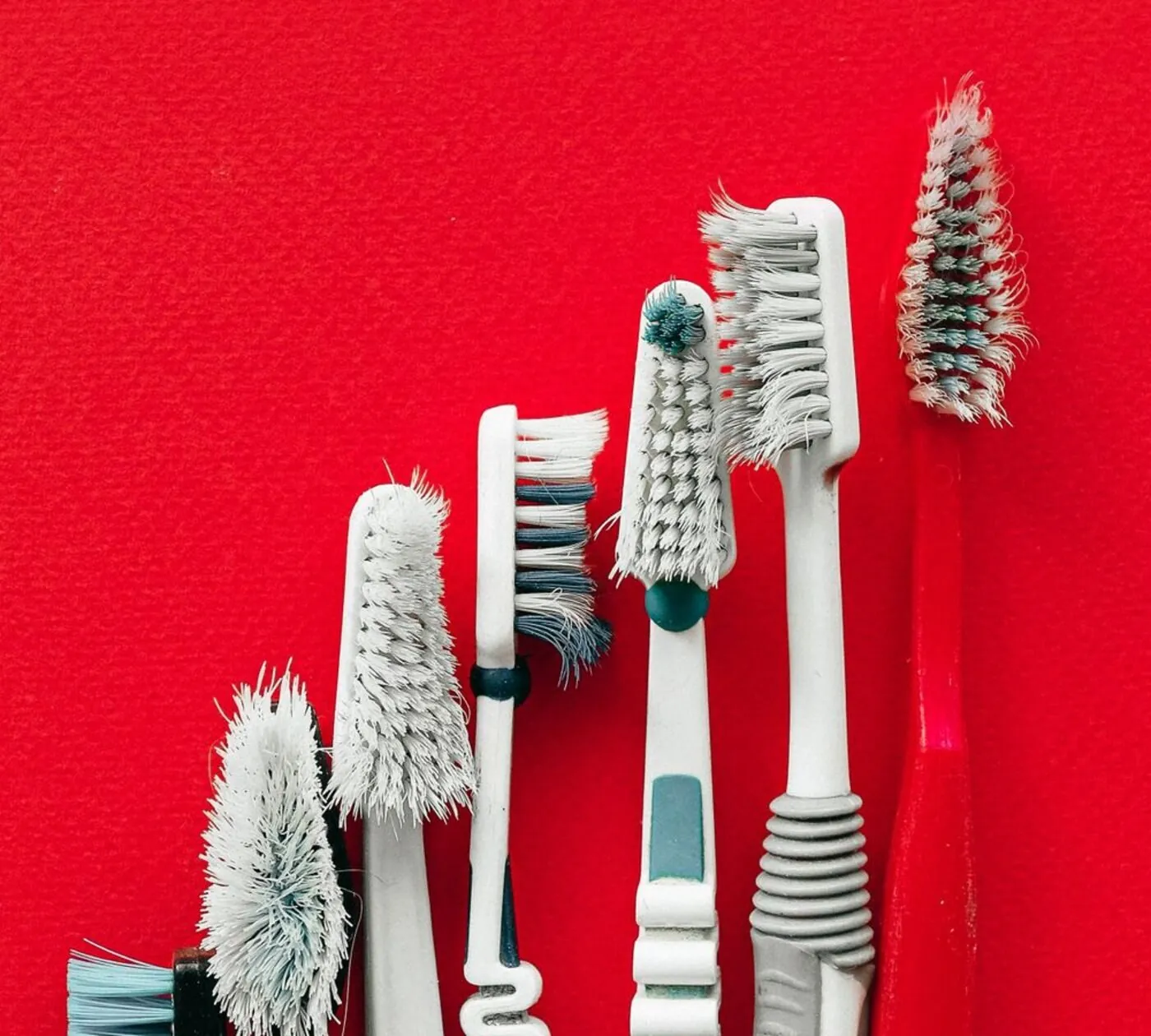
From there comes the second half of the myth: "soft ones don't hold up, I need something firmer." The logic is backwards. If the field opened up from excess force, firmer fiber will not remove that force — it passes it further along, into the gum and the cervical enamel. Wear is not treated with stiffness.
Note how the ADA words replacement: every 3–4 months, or sooner if the bristles are visibly frayed. The criterion is what the bristles look like, not the date on the receipt. Service life is set by the user: the same model lasts one person four months, another four weeks.
A Filament as a Cantilever Beam: What Happens Under Pressure
A filament is clamped in its socket at one end, free at the other. That is a cantilever beam — one of the most studied structures in mechanics of materials — and behaves predictably.
Its bending stiffness is k = 3EI/L³, where E is the elastic modulus of the polymer, L the free length of the filament, I the second moment of area; for a round section, I = πd⁴/64. Substitute one into the other and the essential part is left: filament stiffness scales with the fourth power of diameter and inversely with the cube of length.
Two consequences get mistaken for defects. First: a thin ultra-soft filament bends visibly earlier than a thick one — not because it is worse, but because of the fourth power; a fifth more diameter changes stiffness by almost a factor of two. Second: taller bristles are softer than short ones at equal diameter — length sits cubed in the denominator.
As long as bending stays within the elastic limit, the filament springs back. Cross that limit and part of the deformation stays. The polymer does not "break" — it remembers a position. The next brushing adds to what is remembered, and after a few hundred cycles the tufts stand open with no load at all. That is the fan.
- Hand — pressing force travels down the handle axis to the head
- Pressure — the filament takes a transverse component and works as a cantilever
- Bending — the filament lies on its side, the tip leaves its working position
- Elastic limit — part of the deformation stops springing back
- Accumulation — hundreds of cycles add up to a permanent angle
- Flaring — the field stands open with no load applied
Material changes the pace. In a randomized study by Cho and colleagues (Materials, 2020), PBT brushes held bristle stiffness more consistently than nylon over three months. The mechanism is water: per filament manufacturers' data, PBT absorbs around 0.1% moisture, nylon 6.12 roughly 0.6–1%, nylon 6 up to a few percent. Water acts as a plasticizer, the elastic modulus drops, permanent deformation sets in sooner. Material shifts the timeline. It does not cancel the cause.
How Much Force Is Actually Needed — and How Much People Apply
Intuition says press harder, clean better. Measurement says otherwise.
In work by van der Weijden and colleagues (1996), cleaning efficacy rose with force only up to a threshold, then flattened into a plateau: extra force stopped giving a proportional gain in plaque removal. The reason follows from the previous section: beyond the threshold, force goes into bending, not plaque. What works is the side of the filament, not the tip, and the tips stop reaching where they should: the gingival sulcus and the interdental space.
The second number is sobering. In another study by the same group (1998), ordinary brushing among 94 participants removed about 39% of plaque on average. People who press hard take off less than half: force compensates for neither technique nor time.
The second multiplier is stroke length. Sawing along the arch drives the bristles through long travel: on each pass the filament bends over an enamel edge, the margin of a filling, the gap between teeth. Vibrating in place, within a couple of millimetres, barely takes it past the elastic limit.
Hence the formula the bristle field records: flaring = force × stroke × time. Not one of the three multipliers is set at the factory. Which makes a toothbrush a rare household object that shows your technique after the fact: it does not measure force in the moment, as a powered brush sensor does, but it totals up the month.
How to Brush So the Bristles Work: Bass, 45°, Three Fingers
The method that removes all three multipliers was described by Charles Bass in 1954 and has not changed since.
The brush is held at 45° to the gum line, so the tips enter the gingival sulcus instead of landing flat on enamel. Strokes are short and vibratory, within one or two teeth, no lengthwise sawing; then a sweep from gum toward the incisal edge. The arch is covered in sections.
The modified Bass technique has clinical support: in Poyato-Ferrera and colleagues (Int J Dent Hyg, 2003) it beat habitual brushing for plaque removal. The full home-care sequence is in "How to Brush Your Teeth Properly"; what matters here is only the part that decides the fate of the bristles.
One word on the "feeling of clean" people press for. It comes from friction, not removed biofilm. Top it up with something other than force: two full minutes instead of forty, plus daily interdental cleaning, change the picture far more than pressure.
When Flaring Is Normal and When It Is a Manufacturing Defect
The line runs not through the calendar but through what came apart.
Field wear — the bristles or single tufts have opened into a fan, tips curled outward, the head has lost its rectangle. This is use, and no standard governs it: ISO 20126:2022 sets safety requirements for a new brush (tuft retention, fatigue testing, tip rounding), ISO 22254:2005 measures tuft stiffness under deflection — also on a new product. Nobody tests flaring in the user's hand.
An anchoring defect — one filament stands above the field and comes out with no resistance: that is the root of the filament, "A Loose Bristle Fell Out of Your Toothbrush".
A tip defect — the brush scratches the gum from day one, tips sharp or burred: that is the rounding operation, "Your Brush Scratches Your Gum".
Three months as a replacement interval is a convention, and less stands behind it than people assume. Most studies do show a worn brush cleaning worse than a new one: Conforti and colleagues (2003) and the Daly group (1996) agree on that. But there is a direct counterweight: Tan and Daly (2002) found no significant difference between a new brush and a three-month-old one. Put honestly: the data are contradictory, and "a worn brush definitely cleans worse" is a stronger claim than the evidence supports.
Read Your Old Brush: A Wear Map by Zone
The useful thing about the fan is that it is uneven: the field opens up where you press too hard. A ready-made map.
Look at a dry brush under side lighting. The toe of the head usually goes first: it reaches the last molars, and reaches them with pressure. Next is the buccal side — the brush is pressed harder against outer surfaces than lingual ones, simply because that is easier to lean into. The canines are a zone of their own: the prominent point of the arch takes more load than neighbours.
And above all, asymmetry. If one half of the field opened noticeably more, you press unevenly on the two sides of the arch; for a right-hander, the side that goes first is usually the one easier to reach. Asymmetric wear is asymmetric pressure — and it shows which side is cleaned worse, because where the filament lies on its side, the tips never reach the sulcus.
As for our side: we inspect the tips of our own samples under a microscope, and we know that too much processing during rounding wrecks the filament surface no less than too little. So acceptance is written as a result, not a procedure: share of correctly rounded tips and absence of burrs, not passes over the stones. Ultra-soft fiber forgives less: by the fourth power of diameter it bends sooner and reports technique more honestly. That is a property of the fiber, not a defect.
The answer to "why did the bristles splay" is short, and it is not about the factory. The brush was used as a scraper, not as a brush. It recorded that and showed it — earlier than the gum shows you the same thing.
Cleaning efficacy rises with force only up to a threshold; beyond it the curve plateaus. J Clin Periodontol 1996;23(8):724–729. PMID 8877657
Real-world brushing, 94 participants: average plaque removal about 39%. J Clin Periodontol 1998;25(5):413–416. PMID 9650879
Evidence linking toothbrushing to gingival recession is called inconclusive. PMID 12731692
Brushes after three months of use removed plaque less effectively than new. J Clin Dent 2003;14(2):29–33. PMID 12723100. Counterweight: Tan E, Daly C (J Clin Periodontol, 2002) found no significant difference.
The modified Bass technique outperformed habitual brushing. Int J Dent Hyg, 2003. Primary source of the method: Bass CC, J La State Med Soc 1954;106:57–73 and 101–112.
Sources: van der Weijden GA et al. 1996 and 1998 · JADA 2003 · Conforti NJ et al. 2003 · Daly CG et al. 1996 · Tan E, Daly C 2002 · Poyato-Ferrera M et al. 2003 · Bass CC 1954 · Cho HJ et al., Materials 2020 (PMC7344766) · ADA, Oral Health Topics: Toothbrushes · ISO 20126:2022 · ISO 22254:2005 · filament manufacturers' data
FAQ