№ 53 · SCIENCE
A Loose Bristle Fell Out of Your Toothbrush: Why It Happens and How to Check Yours
August 07, 2026 · QDRO Team
One filament stands taller than the rest and comes out with tweezers, no resistance — usually that's where the story ends. Here it's where it starts: a loose bristle is the only bristle-anchoring defect that ever makes it to the surface. And it comes loose for one reason — nothing was holding it, and no one checked that anything was.
"It's Just One Bristle": Why This Is the Only Defect You Ever See
The usual reaction is to pull it out and forget it — a head holds several thousand filaments, one won't change anything. But bristles sit in blind sockets drilled into the plastic of the head, and whatever happens inside a socket is never visible from outside. A loosely seated tuft you'll only notice once it comes out whole; a staple driven in crooked, you'll never notice at all. Exactly one symptom ever surfaces: a filament that stopped holding.
So "one bristle" isn't really about the bristle — it's about how strictly a given production line controls tuft seating. Unlike the tip, which we cover in "Toothbrush Scratches Your Gums", nobody evaluates the root of a filament — not the packaging, not the reviews, not your eye in the store. There's exactly one myth here: "a filament fell out — bad luck." Bad luck implies randomness. A loose filament has a mechanism.
What the Extracted Filament Showed: Straight, When It Should Be Folded in Half
Seventh day of use. One filament stands noticeably above the trim line — tilt the head sideways to the light and you can see it without magnification. The filament came out with tweezers, no resistance, and turned out to be straight: an even length of fiber, with no fold in the middle.
Why that's a clue becomes clear once you look at how bristles get into the head. The most common method is anchor tufting: a bundle of filaments is fed into a blind socket, folded in half, and a metal staple — the anchor — is driven in on top of the fold. The ends of the staple bite into the socket walls, and the tuft hangs from the fold. Both ends of every filament stick out, which is why a filament is twice as long as the visible bristle.
- Filament — a length of fiber, twice as long as the future bristle
- Fold — the filament is folded in half together with the whole bundle
- Staple — a metal anchor driven into the socket on top of the fold
- Socket — the staple's ends bite into the walls; the tuft hangs from the fold
- Missed by the staple — a filament not caught by the anchor sits loose and works its way out within the first week
A filament pinned by the staple cannot be straight — it's folded in half and can only come out bent, like a hairpin. A straight filament means it wasn't caught by the staple at all — it sat in the socket next to the bundle, held only by the surrounding crowding. That's our conclusion from the anchoring anatomy, not a quote from any standard; but the mechanics don't allow for another explanation.
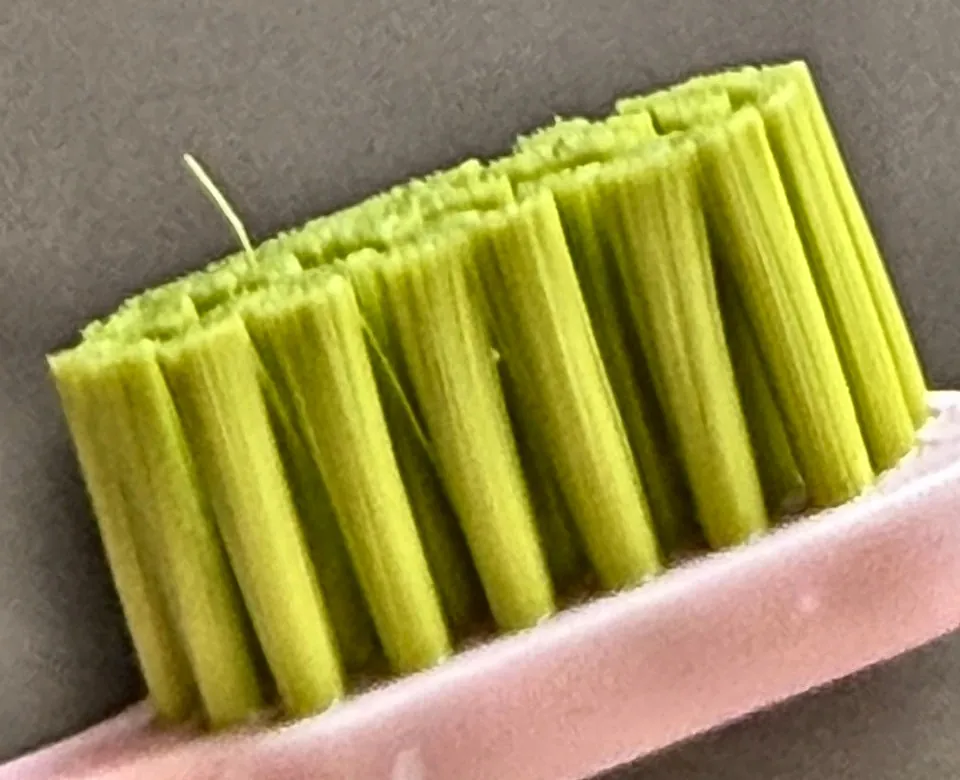
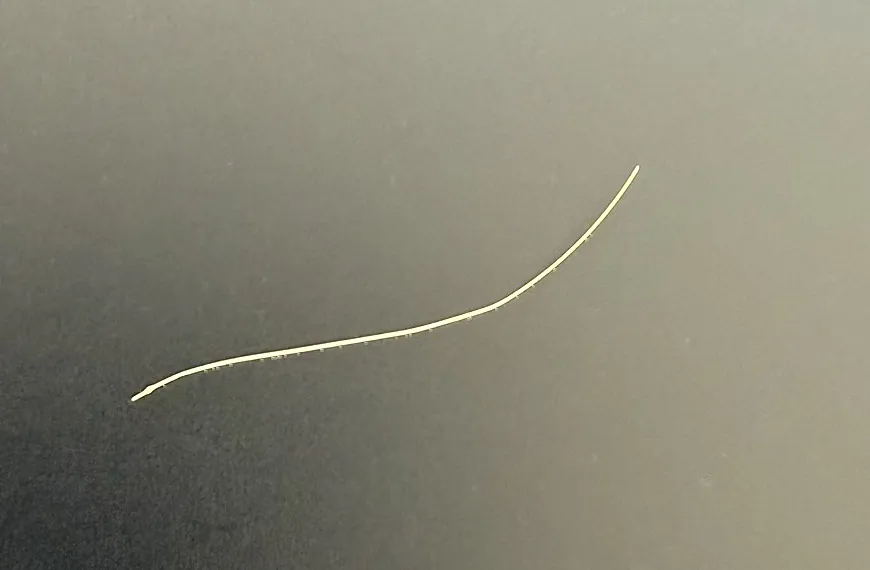
One clarification about the brush in the photo is necessary. It is not a retail product and not an item from our specification — there is no retail brush yet. It's a sample the manufacturer made using its standard process, before we set requirements as numbers; we rejected it as a candidate. That's exactly why it's here: an illustration of what you get when a parameter isn't specified.
The Test Pulls the Whole Tuft. It Cannot See a Single Filament
Bristle anchoring has long been tested. ISO 20126:2022 sets safety requirements for manual toothbrushes, and tuft retention is a standalone clause: a removal force of at least 15 N (clause 4.3). About 1.5 kilograms on a single tuft.
But the number isn't the point — the method is. Under clause 5.4.1.2, the clamp grips every filament of the tuft at once and pulls along the long axis: the tuft is measured as a single unit.
Apply that method to our filament. There are hundreds of filaments in the tuft; one missed the staple. The clamp grips the whole tuft including that filament, the anchor holds the rest — fifteen newtons are reached, the test passes. In this picture, a single unanchored filament simply doesn't exist: it cannot fail the test, and it cannot register in it in any way.
The industry is aware of this blind spot. GOST 6388-91, clause 2.3.5, states it plainly: unanchored bristle is not permitted — no number, no method, no sampling, just a prohibition. The international standard gives a measurable requirement for the tuft and says nothing about a single filament; the older industry standard gives no number but names the problem.
There's a second half to this story, and it matters more than the first: a standard is a floor, not a ceiling. Tip rounding, clause 4.7 of the same ISO, requires at least 50% of ends correctly processed — half. On the production floor, the bar named is 90%, and brushes get rejected against it: a brush whose correctly rounded tips reach only seventy percent still meets the standard on paper, yet fails the internal requirement. The only honest way to put it: ISO sets a minimum of 50%, and 90% is a manufacturer's internal requirement, not a regulation.
Eighteen children's toothbrushes from ten manufacturers under electron microscopy: the share of acceptable tips ranged from 7.2% to 94.4%; three of the eighteen models cleared the 90% bar. Oral Health and Preventive Dentistry. PMID 39037346
Back to the single filament. Where the standard sets a weak number, a manufacturer has something to push above — and you can tell who did. Where there's no number at all, everyone sets their own bar or none at all, and from the outside these two cases look identical. The loose bristle lives exactly in that zone.
Where Orphan Filaments Come From: What They Name on the Production Floor
We put the question — why does a filament end up unclaimed — to the production floors themselves, and they answer it readily: the cause always sits in a specific operation, never in mystery.
The first thing named is an overpacked socket. The tuft is packed too densely, and driving the anchor in cracks the socket wall — that, they say, accounts for most complaints. The opposite case is underfill: less fiber than required goes in, and the tuft sits in "half the socket." After that come the things you would never suspect from the outside: insufficient tension during tufting, socket diameter, the quality of the anchor's copper, anchor wire that runs out in the machine unnoticed, and corrosion of the staple itself.
The lists diverge noticeably — each names what he sees on his own line. One point recurs in all of them, and it always comes first: how many filaments went into the socket. A shared, reproducible variable that is standardized nowhere — no standard sets a requirement for socket fill.
During the audit, we asked them to measure retention on the spot, on brushes from the current shift. An aluminum anchor gave 20–25 N, a copper one about 35 N, against a minimum of 15 N: both clear ISO with margin and look identical on paper, yet the difference is nearly twofold. Aluminum, an engineer with twenty years on the line explained, corrodes: signs appear after about three months — right when the anchoring is still supposed to be working. But copper isn't the finish line either: the copper's quality — grade and wire tolerance — is named separately on the production floor, and the word "copper" in a specification guarantees nothing by itself.
When a Bristle Falls Out and That's Normal
Not every lost filament is an anchoring defect, and it's worth telling the difference before you take the brush back to the store.
- Wear. At three months, the fiber is fatigued, tufts have splayed into a fan, and filaments break at the base
- Snapped on a tooth. Under heavy pressure a filament bends over the edge of the enamel and a fragment breaks off — not the root
- Foreign fiber. A hair or towel lint caught between tufts looks like a bristle, but there's no socket behind it
- Tip splitting. The fiber frays lengthwise at the end — a separate defect, unrelated to tuft seating
There's also a question of scale. The background rate named on the production floor is around 0.1% — roughly one brush in a thousand; take that figure with a caveat, it's an estimate from a production engineer, not a measurement. What matters more is what came after: 0.1% is not treated there as an "acceptable norm" — it's the level at which product gets pulled from the shelf. Zero is unreachable, but "it happens to everyone" is not an excuse.
And there's the question of risk, which tends to get overstated. We found no reported cases of inhaling a toothbrush bristle in the peer-reviewed literature. The one adjacent publication describes a bristle from an interdental brush found in the lip as a foreign body, some time after a dental procedure.
Three cases of foreign-body reaction in the lip, clinically mistaken for other conditions: the material could only be identified using special microscopy techniques, and in one case it turned out to be a bristle from an interdental brush. Head and Neck Pathology. PMID 21046297
The Comb Test: Ten Seconds to Check Your Own Brush
The only anchoring defect that ever surfaces is one you can look for yourself — and in one respect you have an advantage over the lab: it checks a sample from the batch, while you check the actual brush standing in your cup. The tool is your own fingernail. The brush must be dry: wet bristle clumps together and hides anything sticking out. Light from the side: under overhead light, the field looks even even when it isn't.
What follows is what we did about it. Not as an argument in our own favor, but as a list you're entitled to ask of any brand, including us. We caught a loose filament on our own sample and traced the cause instead of writing it off as chance. Following the audit, we switched the anchor from aluminum to copper — retention rose from 20–25 N to about 35 N. And we added a point to batch acceptance that appears in no standard: individual filaments must not stand above the trim line, confirmed by a micro-photo for every batch.
The principle is the same across all three: whatever isn't written into the requirements as a number doesn't get checked. Production without specified parameters runs its "usual way" — and that, too, passes the standard, just at the lower edge.
So if a filament has fallen out of your brush, the answer to "why" is simple, and it isn't about you. The staple didn't clamp it during tufting, and the test that should have caught that pulls the whole tuft and cannot see a single filament. Nothing was holding it — and no one checked that anything was. Ten seconds with a fingernail on dry bristle closes that gap more reliably than any line on the packaging.
FAQ