№ 25 · CHEMISTRY
Whitening strips: what happens to enamel, how peroxide works, and why potassium nitrate changes the rules
June 06, 2026 · QDRO Team
Whitening strips work — this is not marketing. It has been proven in randomized controlled trials. But the mechanism by which they act is far more aggressive than manufacturers usually explain in the leaflet on the package. Hydrogen peroxide literally destroys pigment molecules, penetrating deep into the tooth. The question is not whether it works, but what happens to tooth tissue in the process — and whether that can be controlled.
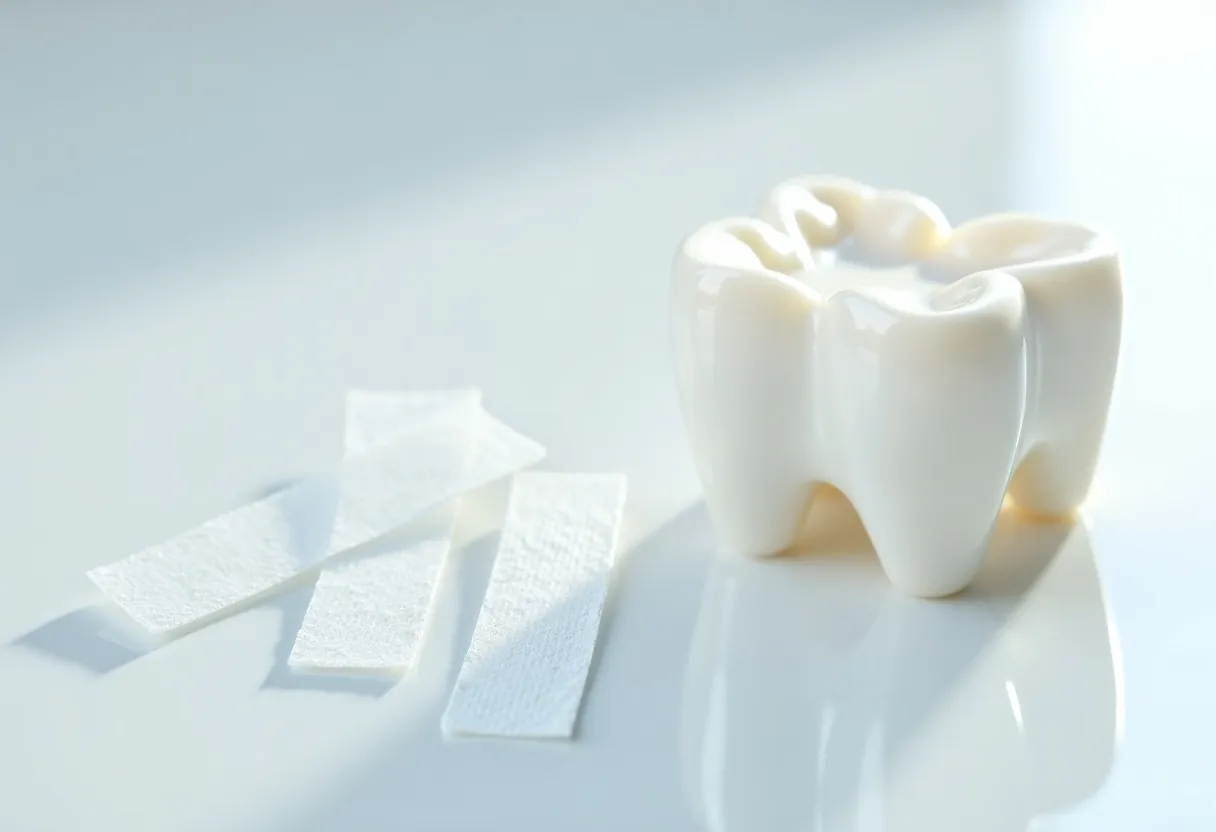
Hydrogen peroxide and free radicals: what actually happens to pigments
Yellowing of the teeth is not surface dirt. Chromogenic molecules — the oxidation products of coffee, tea, wine, and nicotine — bind to the organic matrix of dentin and penetrate through the micropores of enamel. Ordinary brushing or an abrasive toothpaste removes only the external surface stain and leaves deep discoloration untouched.
Hydrogen peroxide (H₂O₂) works differently. On contact with saliva and a mildly acidic environment it dissociates, forming hydroxyl radicals (•OH) and peroxyl anions (HOO⁻). The hydroxyl radical is one of the most reactive oxidants in chemistry: its lifetime is measured in nanoseconds, but in that time it breaks the carbon–carbon and carbon–nitrogen double bonds inside pigment molecules. Large chromophore conjugates fall apart into small colorless fragments. The tooth becomes lighter.
The key condition is that the peroxide has to diffuse to the pigments. The H₂O₂ molecule is small enough (34 Da) to pass through the hydroxyapatite network of enamel, but the rate of diffusion depends on concentration and contact time. The Gerlach meta-analysis (PMID 19233534) showed that strips with 6% H₂O₂ used daily deliver statistically significant lightening (more than 3 shades over two weeks) with a favorable safety profile. This is the fundamental point: 6% is not a “weak” concentration. It is the point at which efficacy and safety coincide optimally.
A meta-analysis of at-home whitening strips: 6% H₂O₂ used daily delivers more than 3 shades of lightening over two weeks with a favorable safety profile.
The sensitivity problem: why it hurts and who is at risk
Roughly 30–40% of people who use hydrogen peroxide strips develop transient sensitivity — sharp pain in response to thermal and osmotic stimuli during the whitening course or immediately after it. According to the review by Alkahtani (PMID 32615235), this sensitivity is as a rule mild and reversible, and it resolves once the course is finished. But the mechanism behind it matters for understanding how to prevent it.
Brännström's classic hydrodynamic theory describes the pain as the result of fluid movement inside the dentinal tubules. Dentin is threaded with millions of tubules 1–2 µm in diameter and filled with dentinal fluid; deep inside each tubule sits an odontoblast process connected to the pulp. When an osmotically active substance — H₂O₂ among them — enters the tubules, it changes the osmotic pressure and sets the fluid in motion. That movement mechanically activates the A-δ fibers of the pulp → sharp pain.
Sensitivity is heightened in people with enamel thinned by acid erosion, bruxism, or gingival recession (exposed cementum protects the tubules less well), and also when strips with a high concentration (10%+) are used without buffering components.
Potassium nitrate: an ionic shield for nerve endings
Potassium nitrate (KNO₃) is not a painkiller in the classic sense. It does not block the pain signal and it does not affect the rate at which peroxide diffuses. Its mechanism of action is subtler and easier to picture.
K⁺ ions from potassium nitrate diffuse along the dentinal tubules toward the pulp and accumulate in the peripheral zone around the A-δ nerve fibers. A high local concentration of K⁺ lowers the neuron's transmembrane resting potential: the membrane depolarizes and enters a refractory state. The nerve fiber becomes less excitable — fluid still moves inside the tubules, but the pain signal is no longer generated with the same intensity.
This is the mechanism dentists call “nerve desensitization.” The Wang meta-analysis (PMID 25913140) confirmed that potassium nitrate (in combination with fluoride) reduces the risk of sensitivity during whitening: the pooled odds ratio was 0.45 (95% CI 0.28–0.73) and the standardized mean difference in pain intensity was −0.47 — with no significant effect on the lightening result. Importantly, the effect is cumulative: K⁺ needs several days of regular use to build up a sufficient concentration in the peripheral dentin. That is exactly why KNO₃ is most effective inside a course of strips rather than in a one-off procedure.
A concentration of 0.80% KNO₃ is the lower bound of activity: the first clinically meaningful data were obtained at 1.4–5%, yet 0.80% combined with nano-hydroxyapatite may produce a synergistic effect through an additional mechanism — physical occlusion of the tubules.
Nano-hydroxyapatite: remineralization during whitening
Hydroxyapatite, Ca₁₀(PO₄)₆(OH)₂, is the principal mineral of enamel and dentin. The nano form (nHAp, particles of 20–100 nm) has fundamentally different properties from micron-sized powder: the particle size is comparable to the crystallites of the biological hydroxyapatite of enamel (~30 nm × 3 nm × 6 nm), which lets them embed physically into defective areas of the surface and partially occlude open tubules.
The study by Dicle et al. 2025 (PMID 40193552) confirmed that applying an nHAp gel after whitening improves the physical and mechanical properties of the enamel surface — it raises microhardness and the Ca/P ratio and lowers roughness — without any loss of whitening efficacy. The mechanisms are twofold: (1) direct adsorption of particles into zones of micropores and early erosion; (2) delivery of Ca²⁺ and PO₄³⁻ ions into the saliva-adjacent space for ion exchange with apatite crystals.
The fundamental point: during whitening, nHAp does not compete with H₂O₂ — it makes up the mineral loss through enamel remineralization, the loss that peroxide inflicts on the organic matrix. At the 6% level, peroxide does not meaningfully demineralize enamel on its own (unlike acidic agents), but it does temporarily raise the porosity of the surface layer. The nHAp inside the strip works precisely in that window: while the strip sits on the tooth, mineral particles fill the zones of increased permeability.
The clinical significance of nHAp for sensitivity has been documented directly. In the randomized trial by Browning et al. 2012 (PMID 22863133), an nHAp paste applied after whitening with 7% peroxide statistically significantly reduced the duration of sensitivity (the number of days with symptoms fell roughly by half) compared with placebo — with no loss of lightening. The effect is stronger in combination with other agents, which underlines how much the balance of the formula matters.
“Smart” strips: whitening and remineralization as a single process
The traditional logic went like this: whiten first, restore afterward. A whitening course, then a remineralizing paste or gel. Two separate products, two separate periods.
Modern formulation philosophy is revisiting that split. Put H₂O₂ to break down chromophores, KNO₃ for neural protection, and nHAp for mineral replenishment into a single matrix, and all three processes run at the same time within one session. Peroxide opens the pores of enamel → nHAp fills them right away → K⁺ blocks the neural response to the changes inside the tubules.
This is not merely a convenience. It is a fundamentally different kinetics of interaction with tooth tissue: remineralization begins not after whitening but during it. It also softens the key side effect — the transient demineralization of the surface layer that follows any whitening agent.
The open question is the optimal ratio between the H₂O₂ concentration and the buffering capacity of nHAp. At high peroxide concentrations (~15%+), the rate of surface demineralization outruns the rate of remineralization achievable with any reasonable amount of nHAp. At 6% that balance is reached. Which is why 6% is not a compromise between “weak” and “dangerous” but an evidence-based choice.
Remineralization begins not after whitening but during it. Peroxide opens the pores of enamel — nano-hydroxyapatite fills them right away. That is not a convenience, it is a fundamentally different kinetics of interaction with tooth tissue.
What this means in practice
The clinical data allow several principles to be stated that hold regardless of brand:
The effect depends on contact. The strip has to lie tightly against the tooth surface — any air gap reduces H₂O₂ diffusion. Uneven teeth require longer contact time.
KNO₃ is a course component. A single session gives no neuroprotective effect. K⁺ ions accumulate in dentin gradually; a stable reduction in sensitivity builds up by day 3–5 of the course.
nHAp is most effective right after whitening. Even if the strip contains nHAp, applying an additional nHAp paste or gel within an hour of the session increases the mineralizing effect — the surface is still open.
Sensitivity ≠ damage. Transient pain is a neural response, not destruction of enamel. However, if sensitivity persists for more than 5–7 days after the course, that is a reason to see a dentist, since there may be an accompanying condition: caries, an enamel crack, or pulp inflammation.
Whitening strips are one of the best-studied over-the-counter dental products. Their chemistry is understood, their risks are documented, and new dual-action formulas (whitening plus remineralization) make it possible to shift the balance toward restoration without sacrificing the result.
Sources:
- PMID 19233534 — Gerlach RW, J Dent, 2009 — meta-analysis of the efficacy and safety of strips with 6% H₂O₂ over two weeks
- PMID 32615235 — Alkahtani R, J Dent, 2020 — review of tooth whitening: chemistry, safety, reversibility of sensitivity and enamel damage
- PMID 25913140 — Wang Y et al., J Dent, 2015 — meta-analysis: potassium nitrate and fluoride reduce sensitivity during whitening
- PMID 40193552 — Dicle AT et al., Oper Dent, 2025 — nHAp gel improves enamel properties (microhardness, Ca/P) after whitening
- PMID 22863133 — Browning WD et al., J Esthet Restor Dent, 2012 — RCT: nHAp paste reduces whitening-related sensitivity