№ 03 · SCIENCE
Inside the Toothbrush: What Science Says About Bristles
June 04, 2026 · QDRO Team
A toothbrush is chosen by two parameters: stiffness and price. Both are the wrong ones. Stiffness affects the hard tissue of the tooth far less than the condition of the enamel itself, and price guarantees nothing about the one thing that decides the outcome for the gums: the shape of the bristle tip. And that parameter is not printed on the package.
Stiffness: Soft Does Not Save You, Hard Does Not Kill You
The conventional view is that a hard brush wears enamel away. A 2016 PLOS ONE study (PMC4829200) tested this in the laboratory and produced an unexpected result.
On eroded dentin — a surface already damaged by acid — soft, medium, and hard brushes came out roughly the same: there is no statistically significant difference between them. Eroded dentin, meanwhile, lost 3.5–5 times more tissue than healthy dentin, regardless of stiffness.
The conclusion is an awkward one for marketing: if enamel has already been damaged by acid from soda, fruit, or reflux, changing the stiffness of the brush will do nothing. The problem is not the brush — it is the acid load and the absence of remineralization.
That does not mean stiffness is irrelevant. It is a question of which tissue. On hard tissue there is almost no difference; on the mucosa there is. A hard brush used with the wrong technique — horizontal strokes under pressure — means cervical abrasion and gum recession. A soft brush leaves a margin for error in technique.
| Category | Diameter (mm) | Who it suits | Risks |
|---|---|---|---|
| Ultra-soft | 0.10–0.12 | Recovery after surgery, periodontitis, hypersensitivity | Insufficient plaque removal with passive brushing |
| Soft | 0.12–0.15 | Most adults, children, braces | Minimal |
| Medium | 0.15–0.17 | Healthy enamel, correct technique | Abrasion with horizontal strokes |
| Hard | 0.18–0.20 | Dentures, specific clinical indications | Gum recession, cervical abrasion |
Modern brushes use several types of synthetic bristle: nylon 6.12 as the industry standard, nylon 6.6 in the budget segment, and PBT, a stiffer polyester material. Natural bristle accumulates moisture and bacteria, and dental associations do not recommend it. On polymer chemistry and the mechanical properties of each material — what toothbrush bristles are actually made of: Pedex, PBT, and nylon.
End-Rounding: The Parameter That Is Not on the Package
Here is what actually decides the outcome for soft tissue — and what you will see neither in the product description nor with your own eyes.
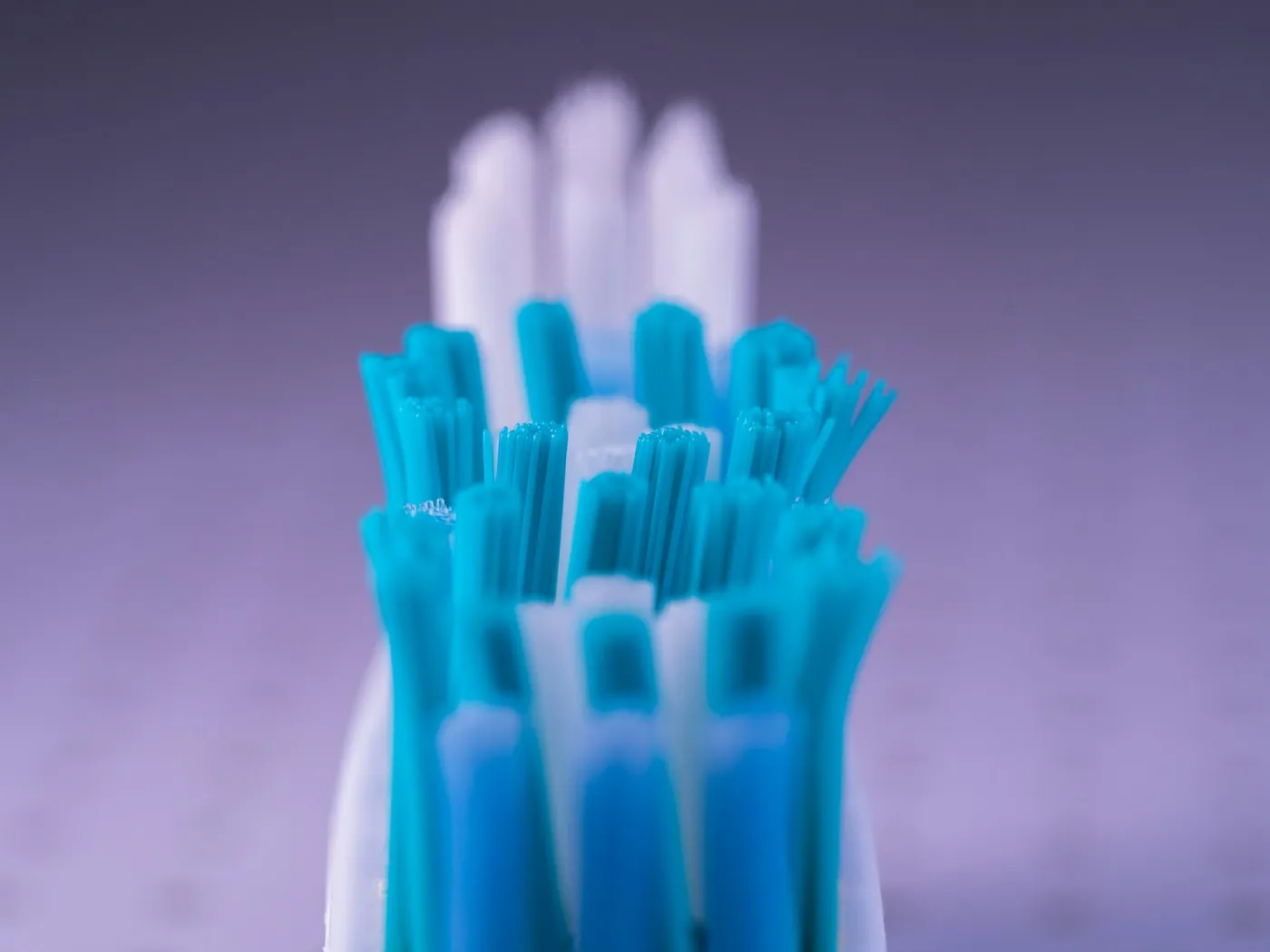
A sharp bristle tip is a micro-needle. Over a single brushing it touches the gums hundreds of times. The ADA safety standard requires at least 90% of tips to be rounded to a defined radius. The market does not meet that requirement.
Of eighteen brushes tested, three cleared the 90% threshold. In earlier work from 2001–2004, only four brands out of thirty-one had more than half their tips rounded. And in a separate study using electron microscopy on children's brushes, the share of rounded tips fell to 1.4–20%.
Most brushes on the market do not meet the basic safety standard — and there is no way to verify it by eye. A sharp tip is visible only under a microscope.
The practical implication is simple. If your gums bleed after brushing under relatively light pressure, the cause may not be periodontal disease but the quality of the brush. A detailed look at how the cut end is processed and how much rounding is enough — your brush scratches your gum: what's wrong with the bristle tips.
Eighteen commercially available toothbrushes were tested for end-rounding. Only 3 of 18 cleared the 90% threshold that the ADA sets as its safety standard.
The Paste the Brush Works With
The second parameter, the one that weighs more than stiffness, is not in the brush at all.
Toothpaste contains abrasives: silica or calcium carbonate particles. Their aggressiveness is measured in RDA units. Dentists consider up to 250 RDA safe for lifelong use (ISO 11609) — but that is at normal pressure and with correct technique.
A 2022 study (PMC9378893) found that an RDA 208 paste produced 4.46 µm of dentin loss and an RDA 69 paste 2.86 µm. The 56% difference was obtained with one and the same brush. The interaction between brush stiffness and paste abrasivity is statistically significant only for dentin, not for enamel. In other words, the combination of a soft brush plus a lowered RDA matters above all where dentin is exposed: at uncovered roots and cervical margins.
There is a third variable as well — bristle density. The total contact area equals the number of filaments multiplied by the area of a tip. At high density, the load on each individual tip is lower at the same hand pressure.
| Brush class | Filament count |
|---|---|
| Premium ultra-soft | 5,000–7,000 |
| Mass-market models | 3,500–4,500 |
Which leads to this: a high-density brush makes it possible to lower the working RDA of the paste without losing cleaning quality — total contact is greater while peak pressure per point is lower. One caveat is obligatory: this follows from the physics of load, not from a clinical trial — direct comparative research on bristle density is still insufficient.
A breakdown of the RDA scale itself and the figures for specific pastes — toothpaste abrasivity: what RDA actually means and which one you need.
What the Measurements Show
Special Coatings: What Is Proven and What Is Not
This is where what is sold most often does not exist. Let us take it in order.
Charcoal bristles. Two studies (PMC6104356, n = 50; PMC7791587, n = 30) found that charcoal bristles accumulate roughly half as many bacteria on the filaments themselves as ordinary nylon does. The effect is real and has been reproduced. But no study has shown that any improvement in oral health follows from it. The systematic review by Khan et al., 2023–2024, rated the results as "unclear"; the 2019 British Dental Journal review found "insufficient evidence for antibacterial claims." The honest claim is "reduces bacterial accumulation on the brush itself." Not "kills bacteria in the mouth."
Silver and zinc. A 2020 study (PubMed 32298860) showed that the mere presence of silver or zinc in the bristle does not predict an antibacterial effect — what decides it is the bioavailability of nanoparticles at the surface. Over the entire life of a brush, no more than 10 ng of silver is released, and of that, 2.8% is in the nanoparticle form that actually interacts with bacteria.
Salt, calcium, and hydroxyapatite on bristles. There is no published clinical data on any of them. Remineralization "through the brush" also faces a mechanical objection: the contact time between bristle and tooth surface is too short for ion exchange.
| Coating | Proven effect | Not proven | Source |
|---|---|---|---|
| Charcoal | About half as many bacteria on the brush | Improvement in oral health | PMC6104356, PMC7791587 |
| Silver / zinc | Depends on nanoparticle bioavailability | Antibacterial action without surface data | PubMed 32298860 |
| Salt | — | No clinical data | — |
| Calcium / nHAp | — | No clinical data | — |
What to Do Tomorrow Morning
- Tips — look for an explicit statement that the bristles have been mechanically rounded; this matters more than brand or price
- Softness — soft or ultra-soft for most people; hard only where there is a clinical indication
- Density — with recession or sensitivity, take a model with a high filament count
- The paste to pair it with — above RDA 100, a soft brush, minimal pressure, vertical strokes
- Service life — replace it every two months: deformed bristles clean worse and more often have damaged tips
A toothbrush is a tool. It works well when it is matched to the job and to the paste it will be working with.
Sources: PMC4829200 (Wiegand et al., PLOS ONE, 2016) · PMC11619842 (2024, end-rounding study) · PMC6104356 (Thamke et al., 2018) · PMC7791587 (2020) · PubMed 32298860 (silver/zinc study, 2020) · Khan et al. systematic review 2023–2024 · BDJ charcoal review 2019 · PMC9378893 (International Dental Journal, 2022) · PMC8764029 (Scientific Reports, 2022) · ADA Oral Health Topics: Toothbrushes · ISO 11609