№ 47 · SCIENCE
"Soft" Is a Word Without a Standard: Geometry Sets a Brush's Stiffness
August 04, 2026 · QDRO Team
Two brushes, both labeled "soft." One feels like a feather. The other leaves a pale stripe along the gum line after a week. And nobody lied: not one standard in the world defines the word "soft," while the real stiffness is set by two numbers that never appear on the package — filament diameter and bristle height. One millimeter of height changes stiffness by roughly a third.
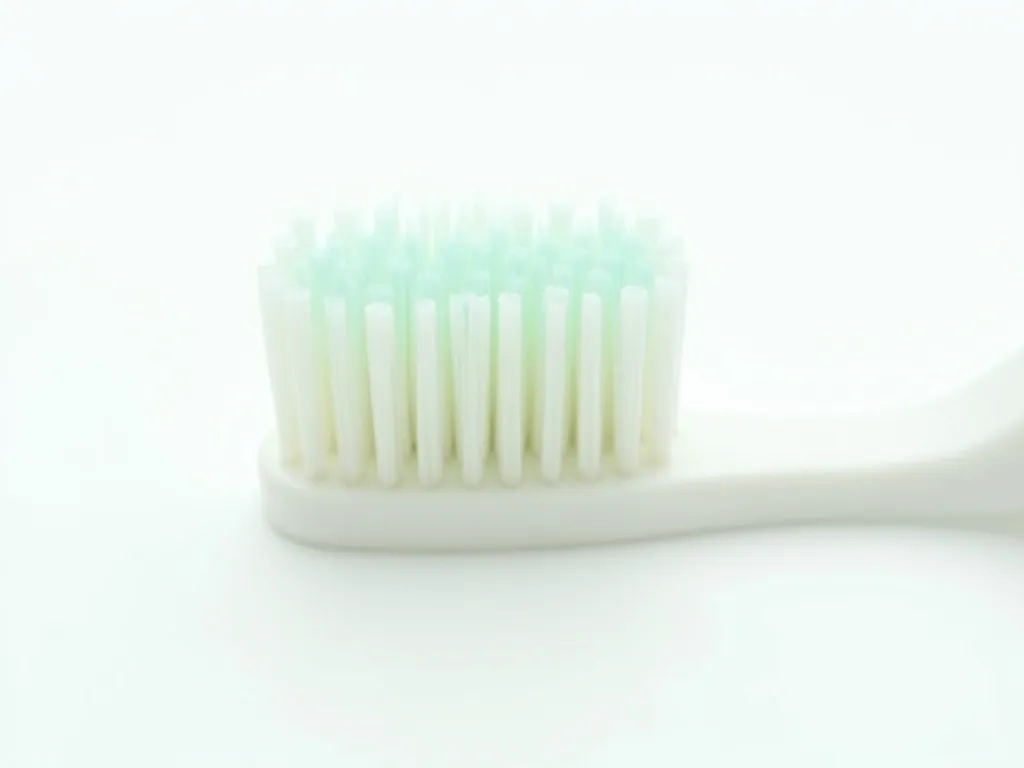
Two "Soft" Brushes, and One of Them Scrapes
The situation is familiar to the point of banality. The dentist said, "get a soft one." You bought a soft one, and it was fine. Then you bought a different soft one because the first was out of stock — and a week later you are brushing warily.
People usually draw one of two conclusions from this: either the brand lied on the package, or "it was a defective one." Both are wrong, and the second especially: the brush is exactly what it was designed to be.
The point is that what you are holding is not "a soft brush." You are holding a specific geometry that the manufacturer decided to call soft, because it had to be called something, and nobody ever gave the manufacturer rules for how.
Words That Nobody Defined
The basic international document for manual toothbrushes is ISO 20126:2022. It is a safety standard, and a fairly strict one. Its requirements section has six items: visual inspection (the brush is intact, with no sharp edges or contamination); tuft retention — a pull-out force of at least 15 N; impact strength of the handle; fatigue resistance — 75,000 cycles without failure; the same fatigue resistance after chemical exposure; end rounding — at least 50% of filaments with no sharp geometry at the tip.
Read that list again. There is nothing in it about stiffness. And not a single number about bristle height either.
A method for measuring stiffness exists separately: ISO 22254:2005, "resistance of tufted portion to deflection." The tuft is pressed down and the resistance is calculated in newtons per square centimeter. But that is a method, not a classification: nowhere does the standard say at what value a brush becomes "soft" and at what value "medium." What is more, it openly notes that the result obtained may not correspond to the consumer's perception of bristle stiffness.
Hence the zoo on the shelf: soft, medium, hard, x-soft, sensitive, ultra-soft, mild — and no shared scale. One brand's "medium" may well turn out softer than another brand's "soft," and the boundary between TePe's X-Soft and the Soft of its neighbor on the shelf is not drawn anywhere.
The only threshold that exists in the industry at all is American. To carry the ADA Seal, a brush must show a stiffness of no more than 6 N/cm² under a vertical load of 5 N; if the measured stiffness is higher, the manufacturer needs a 90-day clinical safety study. That is a "not injurious" threshold, not a translation of a word into a number: an ultra-soft brush and a thoroughly brisk medium both fit under 6 N/cm². Meanwhile, the ADA itself recommends soft bristles for everyday brushing — the very category its own threshold does not separate from medium.
There is one document that does tie the word to numbers — the Soviet GOST 6388-91, "Toothbrushes." And it ties them exactly the right way: through geometry. A stiffness index in arbitrary units (45 to 70 — soft, above 70 to 80 — medium, above 80 — hard) is built up from tuft height, synthetic filament diameter, and the number of rows. A 0.20 mm filament appears in that table both in the "soft" row and in the "hard" row — what separates them is tuft height and pack density. Same material, same thickness, different words on the label. By the rules.
A Formula Thirty-Six Years Old
In 1990, Rawls, Mkwayi-Tulloch, and Krull published a mathematical model of toothbrush stiffness in Dental Materials. The paper is old, has never been refuted, and is remarkably boring — in the sense that the physics in it is high-school physics.
Stiffness = 0.125 · E · (D_B · D_T)² · N_T · P_f / L³
Here E is the elastic modulus of the material, D_B is the filament diameter, D_T is the tuft diameter, N_T is the number of tufts, P_f is the packing factor, and L is the free length of the bristle — that is, the trim height above the head.
What to look at here are the exponents. The diameters enter as the square of a product — for a single filament that is the same fourth power you find in any beam. And the length sits in the denominator, cubed.
From this follows something counterintuitive. The material that packages fight so many battles over contributed nothing noticeable in the authors' measurements: bristle composition and shape, as they write, had no measurable effect on stiffness. The elastic modulus is present in the formula, but against the geometry it gets lost. On the materials themselves and how they differ — what toothbrush bristles are actually made of: Pedex, DuPont Tynex, PBT.
Dental Materials, 6(2):111–117. A first-approximation model: brush stiffness is inversely proportional to the cube of the trim length and grows as the square of the product of the filament and tuft diameters. Bristle composition and tip shape showed no measurable effect on stiffness. PMID 2079171.
Now let us work out what this means on the shelf. Take one and the same 0.15 mm filament and change only the height of the field. Here is what the cube of the length does:
| Free bristle height | Relative stiffness |
|---|---|
| 9 mm | 137% |
| 10 mm | 100% |
| 11 mm | 75% |
This is a calculation from the Rawls formula for one and the same filament, a first approximation — not clinical data. But the arithmetic here is not in dispute: a millimeter of height is not a millimeter. It is a third of the stiffness.
- A 0.15 mm filament, 10 mm free height — the reference point, taken as 100%
- Thicker by 0.02 mm (0.17 mm, same height) — roughly 1.6 times stiffer: diameter works in the fourth power
- Shorter by 1 mm (9 mm, same filament) — roughly 37% stiffer: length works in the cube
- Both changes together — the brush is more than twice as stiff as the original, and the word on the package is the same for both
The third multiplier in the formula is pack density, and it explains the best-known example on the shelf. The Curaprox CS 5460 has CUREN filaments 0.10 mm in diameter, and there are 5,460 of them, against the five to seven hundred thicker filaments of a mass-market brush. The manufacturer calls this ultra-soft, and by the numbers it is right. But another brand's brush with the same 0.10 mm diameter, half the density, and a short field will turn out noticeably stiffer — with the same word on the box, or even with the word "extra soft." The total contact area is the number of bristles multiplied by the area of one tip: the denser the field, the less pressure falls on each point of the gum at the same hand pressure.
Not one of these numbers is printed on the box. Nobody is obliged to print them — we have just walked through every standard there is.
Longer Does Not Mean Worse at Cleaning
Everyday logic says the opposite: scrub harder and it comes out cleaner, while a soft brush is a compromise for people with gum trouble.
In 2023, Axe and colleagues tested this on a robot. Eight manual brushes, replicas of human teeth with model plaque, an automated brushing system — horizontal, rotational, and vertical motions. The human was deliberately removed from the experiment: a live participant masks the difference between brushes with their own technique and pressure. The variables were head size, filament diameter, trim height — 9 mm versus 12 mm — stiffness, and unevenness of the bristle field.
The authors put the result this way: brushes whose filaments are free to flex — longer, softer, and/or with varying filament length — removed significantly more model plaque than standard flat-trimmed stiff ones.
Stiffness is not a bonus to cleaning. It is the price the gums pay for the feeling that the job is done.
The clinical side confirms the second half. In a study by Zimmer and colleagues (2011), 120 volunteers brushed for eight weeks with brushes that differed only in stiffness — forty people each on hard, medium, and soft. The hard brush did indeed give the best plaque indices by week eight. And the same brush gave more gingival damage and higher bleeding indices at weeks four and eight. A systematic review by Ranzan and colleagues (2019), which pooled thirteen studies, comes to the same conclusion: hard bristles mean more soft tissue lesions, while soft and extra-soft bristles produce the fewest adverse effects.
Careful with the first point: a robot is a model. It removes the scatter of technique, but it does not reproduce saliva, the mobility of the cheek, a real biofilm, or a living gum. The correct conclusion from it is more modest, and still inconvenient for advertising: the hypothesis that "stiffer means cleaner" is not confirmed even where it is tested under ideal conditions.
Stiffness with an Expiration Date
And the last thing that undermines faith in the word on the package: stiffness is not a permanent specification of a brush. It is the brush's condition today.
Kaneyasu and colleagues measured the stiffness of PBT brushes every month for three months. In soft brushes it fell from 3.89 to 3.63 N/cm² by two months (the difference is statistically significant, p < 0.01), and in medium ones from 4.52 to 4.18 N/cm² by the third. The filament tires: the bristle stops returning fully to its original position, the field splays, and the brush becomes not "pleasantly softer" but worse.
The same group, in a separate study, photographed the brushes of eighty students and measured the bristle area in the images. The area grew significantly from the first month, while plaque removal efficiency fell significantly by the second. Splaying of the tufts is not visible to the eye right away, but the brush stops working before it becomes visible.
Materials (Basel), 13(12):2802. The stiffness of PBT bristles was measured monthly. In soft brushes it decreased significantly by two months (3.63 versus 3.89 N/cm² at baseline), and in medium ones by two and three months. The authors' conclusion: stiffness falls significantly after two months of use. PMC7344766.
An unpleasant picture emerges. The word on the package is undefined, the numbers behind it are not published, and the stiffness the brush did have at the moment of purchase lasts about two months. The second geometry — the shape of the tips — goes at the same time: your brush scratches your gum: what's wrong with the bristle tips.
How to Read a Brush Without the Label
The good news: the word can be ignored, if you know what to look at instead of it.
- Filament diameter in millimeters. The main lever: it works in the fourth power. The very fact that a brand publishes this number is already a signal — it knows the number and is ready to answer for it.
- Bristle height. The second lever, which almost nobody talks about: with the same filament, a short field is stiffer than a long one, and a millimeter gives about a third. If the height is stated, compare two brushes by it, not by the word.
- Density. The number of tufts and of filaments per tuft enters the formula directly: the more points of contact, the lower the load on each at the same hand pressure. Some brands put that number right into the name: at Curaprox the model number is the bristle count — from CS 1560 (1,560 filaments at 0.15 mm) to CS 12460 (12,460 at 0.08 mm), and the higher it is, the thinner the filament. That is already geometry rather than an epithet, but the scale belongs to one brand; it is not a standard.
- Tips. The shape of the cut is geometry too, but it is responsible not for stiffness but for injury to the mucosa. The details are in the piece on bristle tips.
- Date of purchase. After two months, every parameter above is a different one. This is the cheapest variable of them all: replacing a brush costs less than choosing the "right" one.
Which stiffness suits whom, given the condition of the teeth and gums, is a separate conversation, worked through in the piece on what is inside a toothbrush.
This is exactly why at QDRO we measure the geometry of samples ourselves — with calipers and under a microscope — rather than reading the manufacturer's label. That is not heroism but normal practice for a category where not one standard rests on the word "soft": if a parameter has not been measured on a specific batch, it simply does not exist.
The word on the package does not lie — it simply means nothing. What means something is two numbers: how many millimeters in the filament diameter and how many millimeters in the height of the field. The first works in the fourth power, the second in the cube. Everything else said about stiffness is talk.
Sources: Rawls HR, Mkwayi-Tulloch NJ, Krull ME, Dent Mater 1990 (PMID 2079171) · Axe A et al., BMC Oral Health 2023 (PMID 37880662) · Zimmer S et al., J Periodontol 2011 (PMID 20722532) · Ranzan N, Muniz FWMG, Rösing CK, Int Dent J 2019 (PMID 30152076) · Kaneyasu Y et al., Materials 2020 (PMC7344766) · Kaneyasu Y et al., Int J Dent Hyg 2020 (PMID 31868311) · ISO 20126:2022 · ISO 22254:2005 · ADA Seal of Acceptance, toothbrush requirements, 2026 · ADA Oral Health Topics: Toothbrushes (ada.org) · Curaprox CS product line specifications (curaprox.com) · GOST 6388-91