№ 22 · CHEMISTRY
Mouthwash with and without alcohol: the real difference
June 06, 2026 · QDRO Team
Listerine appeared in 1879 as a surgical antiseptic — long before anyone thought of rinsing their mouth with it. The alcohol in it was not a marketing decision but a technical one: the essential oils of thymol, menthol, eucalyptol, and methyl salicylate do not dissolve in water. A solvent was needed, and ethanol did the job. The burn started as a side effect, then became a signal of effectiveness, then a competitive advantage.
Today most consumers read the burn as proof that the product “works.” Makers of alcohol-free formulas have spent decades trying to overcome that prejudice. The question is what the science says.
Alcohol as a solvent, not as an antiseptic
The first thing worth understanding: at the 20–26% concentration used in standard mouthwashes, ethanol is not the main antimicrobial agent. The minimum bactericidal concentration of ethanol for most oral pathogens is 40% and above. At 20%, alcohol acts mainly as a solvent that holds the essential oils in solution — thymol, eucalyptol, menthol, methyl salicylate — and it is those that are the real active ingredients.
That distinction has practical consequences. If alcohol is only a carrier, it can be replaced. And replaced without losing effectiveness — provided the essential oils are converted into another form (cyclodextrin complexes, nanodispersions, emulsifiers).
The Lynch et al. 2018 RCT (PMID 29321067) compared the alcohol-containing and alcohol-free versions of an essential-oil mouthwash in a six-month parallel design: no statistically significant difference in plaque or gingivitis was found between the groups. The van Swaaij et al. 2025 meta-analysis (PMID 39133629), covering 7 studies, confirmed the point: with comparable active ingredients, alcohol-containing formulas are marginally ahead of alcohol-free ones on the plaque index — but the difference is not clinically significant. The authors of both papers concluded that efficacy is determined by the active ingredients, not by the presence of ethanol.
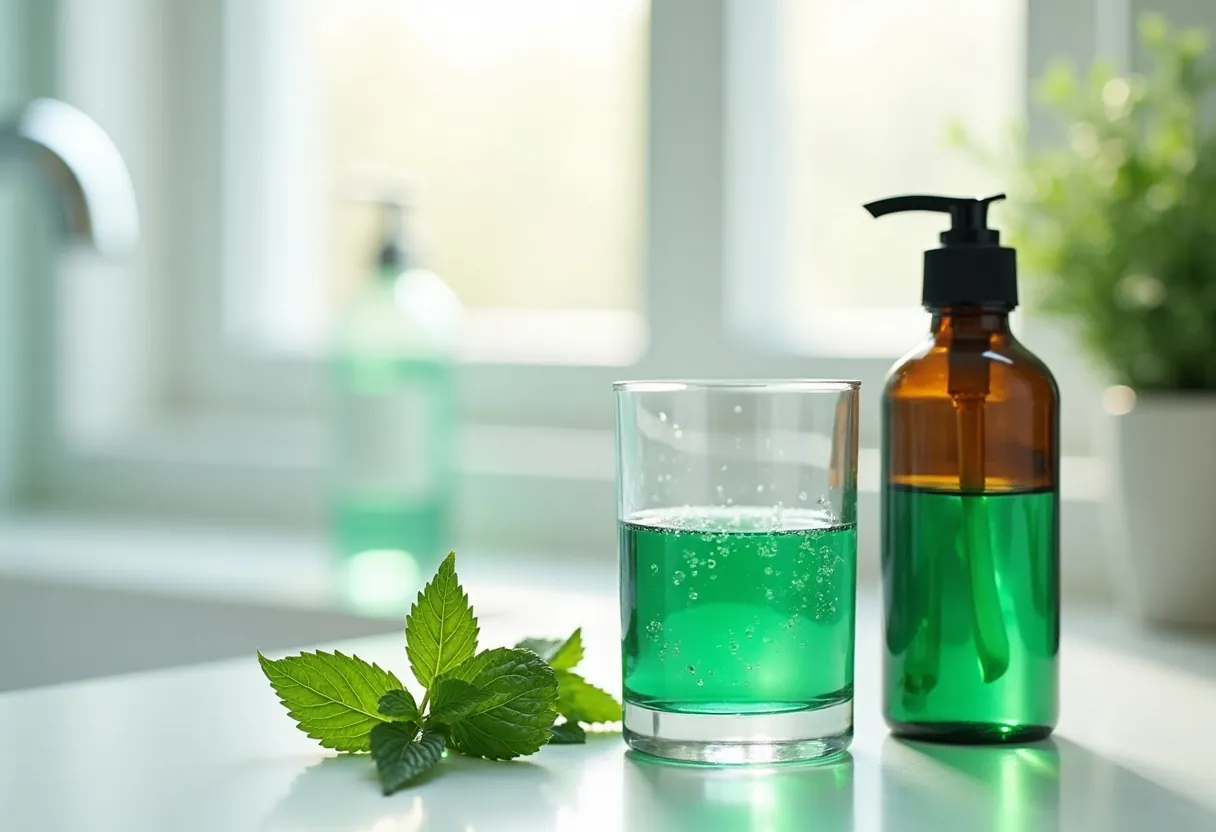
The first head-to-head comparison of two branded essential-oil mouthwashes — one with alcohol, one without. A six-month parallel RCT: no statistically significant difference in plaque or gingivitis. Efficacy is determined by the active ingredients, not by ethanol.
7 studies. Alcohol-containing formulas are marginally more effective on the plaque index, but the difference is not clinically significant. On gingivitis — no difference.
Clinical data on alcohol-free formulas broadly confirm this: with equivalent active ingredients, an alcohol-free essential-oil mouthwash is no weaker in antibacterial activity. The burn goes down; the effectiveness does not.
Xerostomia and other unwanted effects
Ethanol is a dehydrating agent. In regular contact with the oral mucosa it disrupts the barrier function of the epithelium, reduces saliva secretion, and changes saliva's composition. That state is xerostomia, or dry mouth syndrome — not merely discomfort, but a clinical problem.
Saliva is the mouth's first line of immune defense. It contains lysozyme, lactoferrin, immunoglobulin A, histatins, and other antimicrobial peptides. When salivary secretion falls, pH shifts (acidity rises), the concentration of protective proteins drops, and carbohydrate clearance deteriorates. The paradox: a mouthwash meant to improve hygiene can, with chronic use, create conditions that favor Streptococcus mutans and Candida flora.
The data here, though, are mixed. The head-to-head RCT by Nair et al. 2018 (PMID 29164661) compared alcohol-containing and alcohol-free mouthwashes used twice a day for a week and found no statistically significant worsening of xerostomia from short-term use of the alcohol formula. In other words, for a healthy person rinsing for a few days, the risk of dryness is minimal. The concern applies above all to chronic daily use and to groups whose salivation is already impaired — older adults, people taking antihypertensives or antidepressants, patients with Sjögren's syndrome. In them, an additional dehydrating agent can aggravate discomfort and worsen the hygiene outcome.
A separate matter is the interaction with dental restorations. Ethanol softens some composite resins and can leach components out of polymer matrices on prolonged contact, which is relevant for patients with a large volume of restorative work.
Oral cancer: what the epidemiological data say
This is the sharpest question in the whole topic — and the most ambiguous. In 2008 the Australian researchers McCullough and Farah published a review (PMID 19133944) raising the question of a possible role for alcohol-containing mouthwashes in oral carcinogenesis. The paper drew wide attention (and a series of rebuttals in the same journal) and set off a wave of meta-analyses.
The data proved inconsistent. The quantitative meta-analysis by Gandini et al. 2012 (PMID 22742785), covering 18 epidemiological studies, found no statistically significant association between regular mouthwash use and the risk of oral cancer (RR 1.13; 95% CI 0.95–1.35); for alcohol-containing formulas taken separately, the association was likewise absent (RR 1.16; 95% CI 0.44–3.08). The larger pooled analysis by Boffetta et al. 2016 (PMID 26275006) from the INHANCE consortium — 8,981 head and neck cancer cases and 10,090 controls from 12 studies — also showed no overall increase in risk (OR 1.01; 95% CI 0.94–1.08). A signal appeared only in individual subgroups: oral cavity cancer OR 1.11 (95% CI 1.00–1.23), oropharynx OR 1.28 (95% CI 1.06–1.56), and among those who used mouthwash more than once a day (OR 1.31; 95% CI 1.09–1.58) or for longer than 35 years. The authors state plainly that these data make it impossible to separate the effect of the mouthwash itself from concurrent smoking and drinking.
The mechanism, if the association is real, is presumably as follows: ethanol is metabolized in the mouth into acetaldehyde — a known Group 1 carcinogen in the IARC classification. Salivary bacteria take part in that metabolism; an alcohol-containing mouthwash could, in theory, raise the local concentration of acetaldehyde.
An important piece of context: the WHO has not placed alcohol-containing mouthwashes on its list of probable or established carcinogens. The organization words its position cautiously: observational data do not allow a causal link to be established; prospective cohort studies are needed. Most leading professional dental associations — including the ADA and the British Dental Association (BDA) — do not recommend restricting the use of alcohol-containing mouthwashes in healthy non-smoking adults, but they do acknowledge that for at-risk groups (smokers, people who drink, patients with precancerous changes) a switch to alcohol-free alternatives is a reasonable precaution.
When an alcohol-free formula is objectively better
There are several clinical situations in which choosing alcohol-free is not merely a “preference” but a justified position.
Children under 12. Not because of direct toxicity — because of the risk of accidental swallowing. A 500 ml bottle of a standard mouthwash at 21% ethanol contains about 100 ml of pure alcohol. Pediatricians are unanimous: for children, alcohol-free formulas only.
Pregnant women. There is no evidence of teratogenicity, but the principle of minimizing exposure is justified.
Sjögren's syndrome and drug-induced xerostomia. In patients whose salivation is already impaired, an additional dehydrating agent worsens quality of life and the hygiene outcome.
People in recovery from alcohol dependence. Here it is not biochemistry but psychology: the smell and taste of ethanol can be a trigger. Dentists who work with such patients routinely recommend alcohol-free products.
Patients with aphthous ulcers and mucositis. Alcohol irritates damaged mucosa and slows the healing of ulcers. The MASCC/ISOO systematic review and clinical guidelines on basic oral care in mucositis (Hong et al. 2019, PMID 31286232) rely on gentle, non-aggressive measures — saline and baking-soda rinses, multi-component protocols — rather than on irritating ethanol-containing formulas.
How to read the ingredient list if you want to know what you are buying
An “alcohol-free” label says nothing about actual effectiveness. An alcohol-free mouthwash may contain cetylpyridinium chloride (CPC), chlorhexidine, fluoride, zinc, probiotic lysates — different active ingredients with different profiles of indications and limitations. Or it may contain nothing but fragrances and preservatives — that is, it may be scented water.
The key questions when choosing:
- What is the active ingredient, and at what concentration?
- Are there clinical data (RCTs, not in vitro work) for this specific formulation?
- Does the formulation match your situation (plaque prevention, gingivitis, sensitivity, whitening)?
The burn does not mean “it works.” Its absence does not mean “it does not work.” A mouthwash's effectiveness is determined by its active ingredients — not by its solvent.
For a healthy adult with no specific indications, the difference between an alcohol-containing and an alcohol-free essential-oil mouthwash is minimal, provided the concentrations of the active ingredients are equivalent. The burn does not mean “it works.” Its absence does not mean “it does not work.”
An alcohol-free base built this way is particularly relevant for people with sensitive mucosa and for teenagers aged 12 and up, who should not have to trade effectiveness for comfort. Once the essential oils are converted into a water-soluble form, antibacterial activity is not compromised.
The practical bottom line: if you are healthy, do not smoke, and use mouthwash once a day, the type of solvent will not change your clinical results. If you have xerostomia, belong to a risk group for oral cancer, are undergoing chemotherapy, or simply want a product without the excess burn — an alcohol-free formula with equivalent active ingredients is a justified and sufficiently well-studied choice.
Sources:
- PMID 39133629 — van Swaaij et al., Int J Dent Hyg, 2025 — meta-analysis of 7 studies: alcohol-containing and alcohol-free essential-oil mouthwashes differ only marginally on plaque, and not at all on bleeding and gingivitis
- PMID 29321067 — Lynch et al., BMC Oral Health, 2018 — 6-month RCT: no significant difference in plaque or gingivitis between the alcohol and alcohol-free essential-oil formulas
- PMID 26227646 — Araujo et al., J Am Dent Assoc, 2015 — meta-analysis of 29 RCTs: essential-oil mouthwashes produce a clinically meaningful reduction in plaque and gingivitis as an adjunct to mechanical hygiene
- PMID 28359280 — Marchetti et al., Trials, 2017 — crossover RCT: alcohol-free Listerine Zero and the alcohol-based essential-oil formula suppress plaque regrowth equally (the difference is not significant)
- PMID 22742785 — Gandini et al., Ann Agric Environ Med, 2012 — quantitative meta-analysis of 18 studies: no significant association between mouthwash and oral cancer (RR 1.13)
- PMID 26275006 — Boffetta et al., Eur J Cancer Prev, 2016 — INHANCE pooled analysis (12 studies): no overall increase in risk (OR 1.01); a weak signal only in subgroups and in frequent/long-term users
- PMID 19133944 — McCullough & Farah, Aust Dent J, 2008 — review that raised the question of the role of alcohol-containing mouthwashes in oral carcinogenesis
- PMID 31286232 — Hong et al., Support Care Cancer, 2019 — MASCC/ISOO systematic review and guidelines on basic oral care in mucositis: reliance on gentle agents rather than irritating formulas
- PMID 29164661 — Nair et al., J Oral Rehabil, 2018 — RCT: short-term use of an alcohol-containing mouthwash does not worsen xerostomia compared with an alcohol-free one